
Meet the Cast
The heroes, the narrator and the wider cast of The Infrastructure Guard: original characters who explain how power, water, data and public money really work in the AI age. Look for them as guides all over this site.
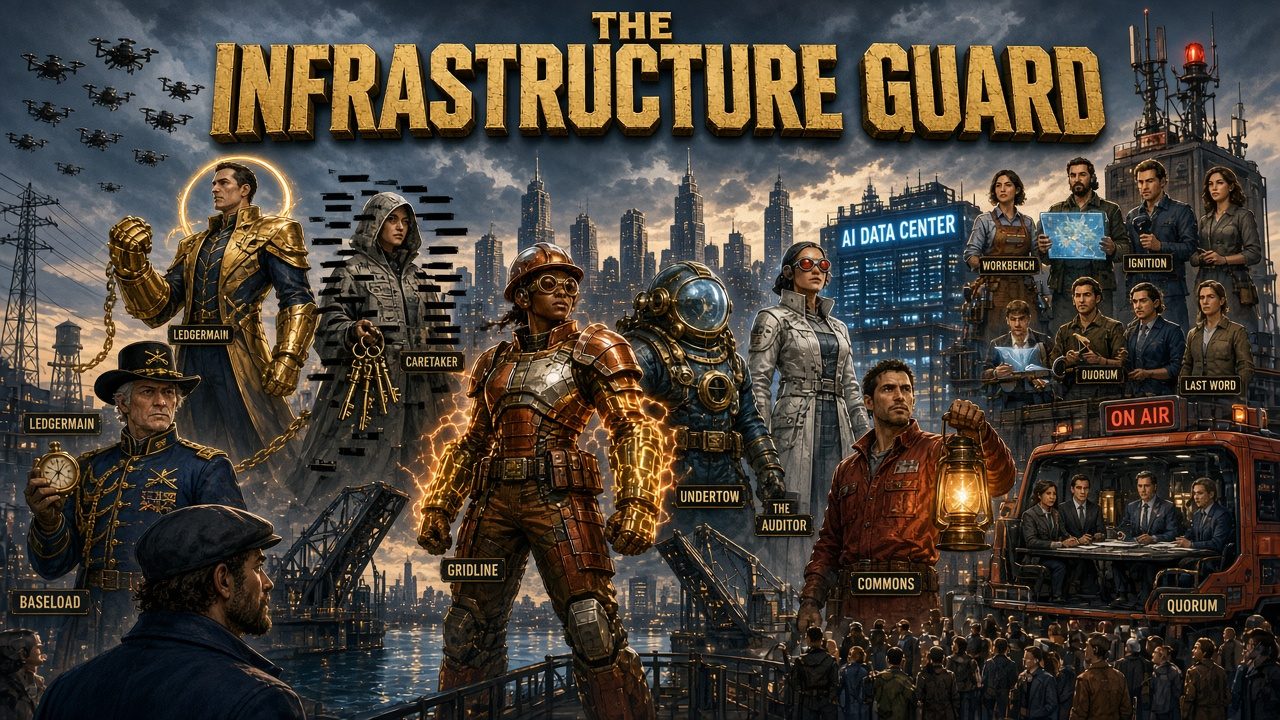

Welcome to the Infrastructure Guard. Four heroes, each with a power and a limit. The limits are the point: nobody here can fix a city alone.
The four heroes
 Gridline
Maeve Okafor · power grid
- Who
- 30s, a former high-voltage lineworker. Steady, practical.
- Look
- Amber-and-copper armor shaped like lineworker gear, a climbing belt with brass fittings and a hard-hat style helm. Faint gold current traces run along her arms.
- Power: Load Sight
- She sees electricity as light across the city and can feel where the grid is strained.
- Limit
- She can’t make new power. She can only show and route what exists.
- Theme
- Power grid, energy costs, who pays for new capacity.
 Undertow
Tomás Vale · water
- Who
- 40s, a water-plant engineer. Quiet, careful, thinks in gallons.
- Look
- A deep-blue armored diving suit with brass pressure gauges and a clear dome visor.
- Power: Flow Read
- He can feel every pipe, intake and aquifer, and see how much water cooling takes.
- Limit
- The lake is shared. Every gallon has a neighbor.
- Theme
- Water use, cooling, shared resources.
 The Auditor
Ines Hartwell · oversight
- Who
- 50s, a former inspector general’s investigator. Precise, fair, unflappable.
- Look
- A long silver-gray coat with a high collar, a thin monocle-style lens that glows white, and a slate clipboard that projects light.
- Power: True Sight
- She can see whether a system is “operating as intended.” Hidden faults glow red.
- Limit
- She can see and report, but she cannot stop anything on her own. Someone else has to act.
- Theme
- Oversight, audits, independent review: who checks the checkers.
 Commons
Ray Delaney · neighbors
- Who
- 60s, a longtime neighborhood organizer turned community advocate. Big laugh, bigger memory.
- Look
- A brick-red work jacket over armor plates like old Chicago common brick, and an iron lantern that reveals a crowd of neighbors standing behind him.
- Power: The Room
- He turns a neighborhood’s voice into a visible force, like a public hearing made real.
- Limit
- His strength only comes when people show up.
- Theme
- Host communities, community benefit agreements, local approvals.
Narrator and a familiar face
Declan SheaNarrator · bridge-tender
- Voice
- Warm Irish lilt, older, unhurried, kind, a little dry.
- Rule
- Short sentences. Explains, never sells. One gentle line of wit per episode at most, never at anyone’s expense.
 Baseload
Col. Hollis Brandt, ret.
- Who
- A retired colonel who checks his watch like the grid owes him money.
- Theme
- Priority power for defense computing: the strongest case for who gets served first, and what it costs the neighbors.
New on the route
 Clam
ClamFleet rig 214 (a made-up number) · the catch basin truck
- Who
- A heavy-duty city work truck with a boom and a clam-shaped bucket, the kind of machine that lifts mud, leaves and trash out of street catch basins. Twenty years on the route. Doesn’t say much. Kid-friendly name: The Jaw.
- Look
- Dented gray-blue cab, chalk-white hazard chevrons, a rust-orange boom and hydraulic lines, a worn steel bucket, an amber beacon and a chalk tally on the driver’s door. No logos, no faces.
- Power: The Jaw
- He reaches down into the dark and brings up what is choking the city.
- Limit
- One basin at a time, and only what the bucket can reach. He can’t make a pipe bigger. When the rain outruns the pipe, the city needs storage tanks and new sewers.
- Voice
- None. Hydraulic hiss, two horn taps, a rising idle. Declan translates.
- Theme
- Maintenance, catch basins and flooding: pay for the pipe before the rain.
Clam is the first ally who is not a person
The four heroes see, measure, check and gather. Clam works. He is the quiet maintenance crew that keeps a drain open so the rain has somewhere to go. His partner in the field is Undertow (water in, water out). Commons brings the neighbors, and The Auditor keeps the tally honest.
He stars in Pay for the Pipe, or Pay for the Flood, a short episode about how Chicago cleans its catch basins and what flooding costs. Like every character here, he is fictional. The numbers in the episode link to public sources.
Signs and symbols
The Four Layers
Four concentric rings of light around a data hall: amber, blue, silver and brick red. They stand for internal controls, an inside check, an outside auditor and an independent board committee.
The Blank Accord
A single plain page headed “ACCORD,” glowing faintly. It never shows real signatures, and it reminds viewers that a promise is only as good as who checks it.
The Hum
A vast, faceless storm of blue-white light and server-fan roar that rises from a data hall. It stands for scale and unchecked risk. It is a force, never a person or a company.
The wider cast
Character sheets from the series bible. These characters appear in stories still to come.
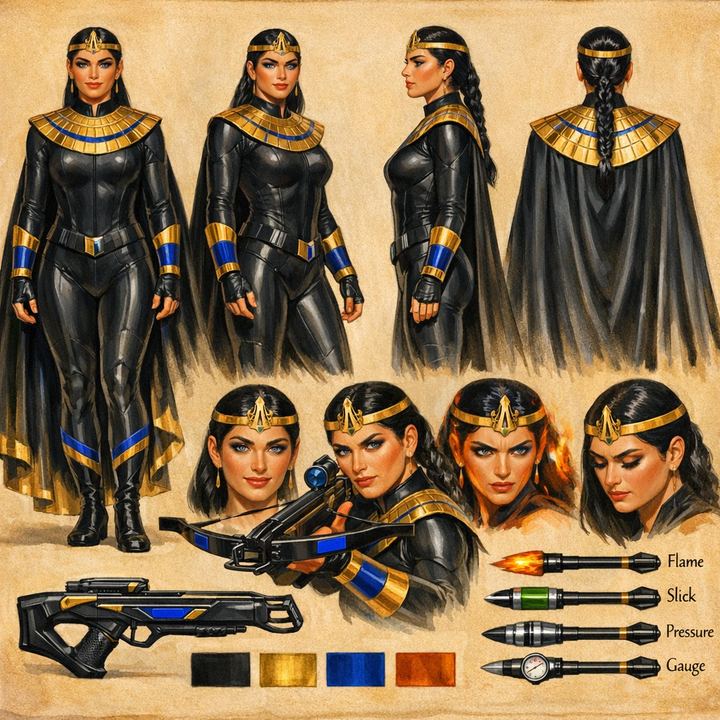 Gasoline
Nadira Sabry Haddad
Every light has a fuel. Price shocks hit the poor first, and bridge fuel needs a sunset date.
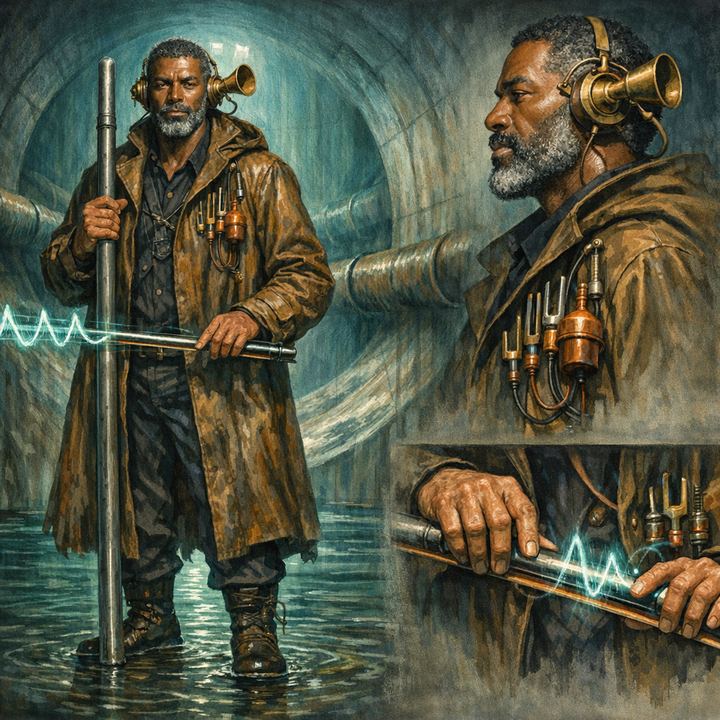 Burrow
Carter Burrough
The city underneath: tunnels, pipes and what the public never sees or hears.
 Linnet
Unit LP-41
A storm-repair robot with a memory she cannot set down: guilt, salvage and what we owe the machines that serve us.
 Plowshare
Jonah Teague
A township electrician facing eminent domain and a transmission corridor. What a community owes and is owed.
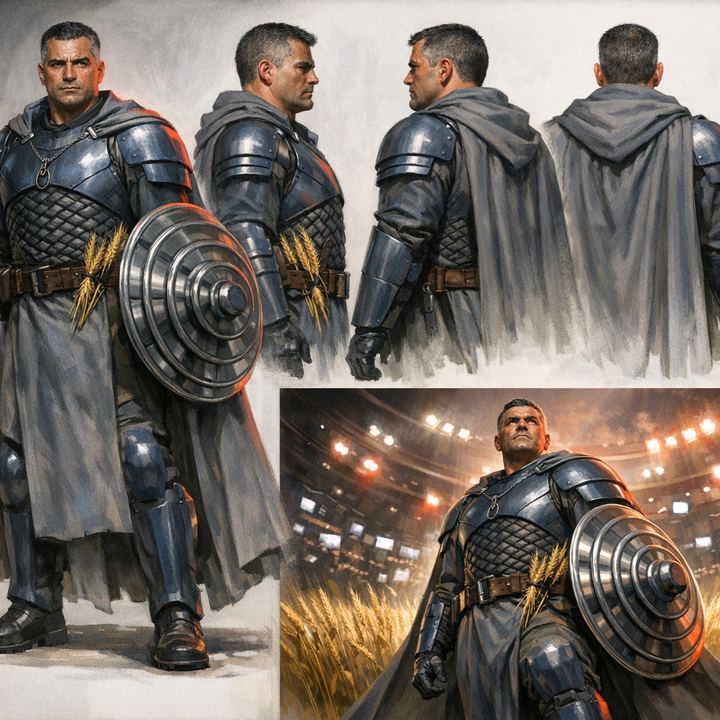 Span
SpanLaz Rourke
The grid is a public trust, and rural feeders should not be shed first.
 Palimpsest
Nora Quill
Records can be erased and rewritten. A claim is not a fact.
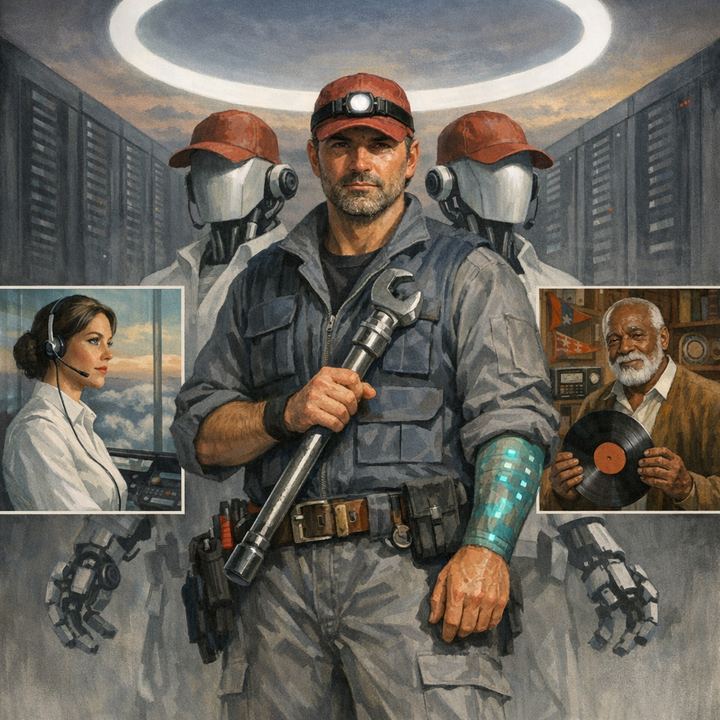 Standby
Cormac Ruark
The last human on standby at a lights-out data hall: digital twins, licenses and a human-in-the-building rule.
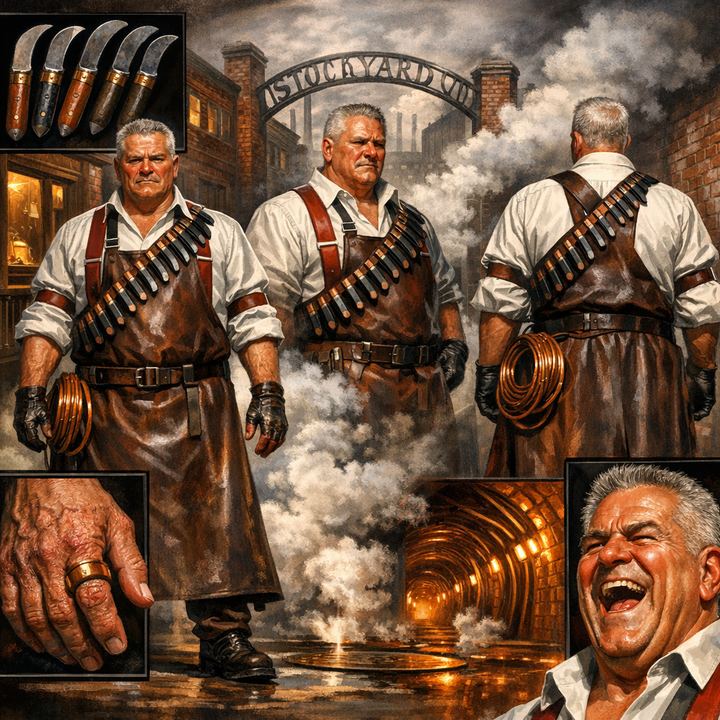 Splicer
Gus Malecki
Alderman of the Yards and boss of the Throat, the old freight tunnel every power and fiber line has to pass. Whoever holds the permits sets the price of the build-out.
 Ledgermain
Cassius Wren
A deal-closer who brings a city money with strings attached. His forecasts glow, until someone reads the real number out loud. She reads the books; he writes them.
How the sagas look and sound
The look
Painted, heroic comic-cover style with soft rim light, low angles and real-world textures: rebar, copper, wet concrete and transmission steel. Dusk over a Midwest skyline, warm sodium-orange streetlight against steel blue.
The sound
Celtic strings and pipes, synth noir and big electronic swells, set under short, deadpan dialogue and a verse or two in the old fireside tradition.
The rules
Fully fictional characters and invented places. No real people, logos or seals. No human villain: the tension is the size of the job and who checks the work. Proven and alleged are always labeled.
Watch them in action
 0:55
0:55Four Rings
The White House AI accord, its four layers of checks, and why power and water stay local.
 0:44
0:44Baseload: Who Gets the Megawatts First?
A fictional plant finds 890 more megawatts. One dry question: who gets them first?
 0:50
0:50Pay for the Pipe, or Pay for the Flood
A fictional catch basin truck, a real Chicago drain program, and the numbers behind it.
Fictional characters. The Infrastructure Guard and all of its characters, places and events are original GOTB creations. Any resemblance to real persons, companies or facilities is coincidental. Real-world facts in each episode link to public sources.

About
Meet Michael E. Brown
President and Managing Partner, GOTB Consulting, LLC · Chicago
Michael E. Brown has 20+ years of governmental and municipal consulting and lobbying experience. He was lead contract negotiator on the $8.5B O’Hare 21 program and the $800M O’Hare rail extension, and lead lobbyist and contract negotiator on the $400M Chicago Department of Water Management lateral redevelopment. (Dollar figures are program sizes, not GOTB fees.)
He has worked with the Illinois legislature and public officials on public-private partnership (P3) policy, and has consulted to the Cook County Commission on reducing duplicative administrative offices. He is a frequent speaker at governmental and municipal functions, focuses on good government and healthier social and economic solutions for safe, successful neighborhoods, lives in Chicago, and serves on the Board of the March of Dimes.
- M.S., Psychology (1997), University of Iowa
- B.S., Psychology (1995), University of Iowa
About
Meet Richard Butler
Partner, GOTB Consulting, LLC · Chicago
Richard (Rich) Butler is a partner at GOTB Consulting and a 38-year veteran of Chicago city government. From August 2019 to February 2020 he served as First Deputy Commissioner and Chief Administrative Officer of the Chicago Department of Aviation (CDA), responsible for day-to-day administration and operations of O’Hare and Midway, including finance, contracts, operations, legal, human resources, workforce development, concessions, real estate and vehicle services. CDA manages the two airports with a federally funded budget of $8.5 billion. (Dollar figures are budget and program sizes, not GOTB fees.)
Before that, Rich was First Deputy Procurement Officer at the City’s Department of Procurement Services and Chief Administrative Officer of the Chicago Park District, where he oversaw procurement, audit, finance, warehousing and general administrative services on an estimated annual budget of $385 million and established district-wide policies and procedures. His City career began at the Department of Aviation as Director of Contracts Administration, and he also served as General Superintendent of the Department of Streets and Sanitation.
He completed the Chicago Accounting and Purchasing System Training Program and the City of Chicago Executive Management Program, was a key team member on the design and implementation plan for the City’s new eProcurement system, and is a member of the National Institute of Governmental Purchasing and the Purchasing Management Association of Chicago. He has served on the board of the Chicago Municipal Employees Credit Union and on the US Communities board, representing the City of Chicago, and traveled to South Korea to represent Chicago in the Kotra Alliance to bridge contracting opportunities. A native of Englewood, he attended De La Salle High School.
- B.S., Northern Illinois University








Fictional characters from GOTB’s original stories. Real-world facts always link to public sources.