Where Health Dollars Live: Chicago, Cook County and Illinois
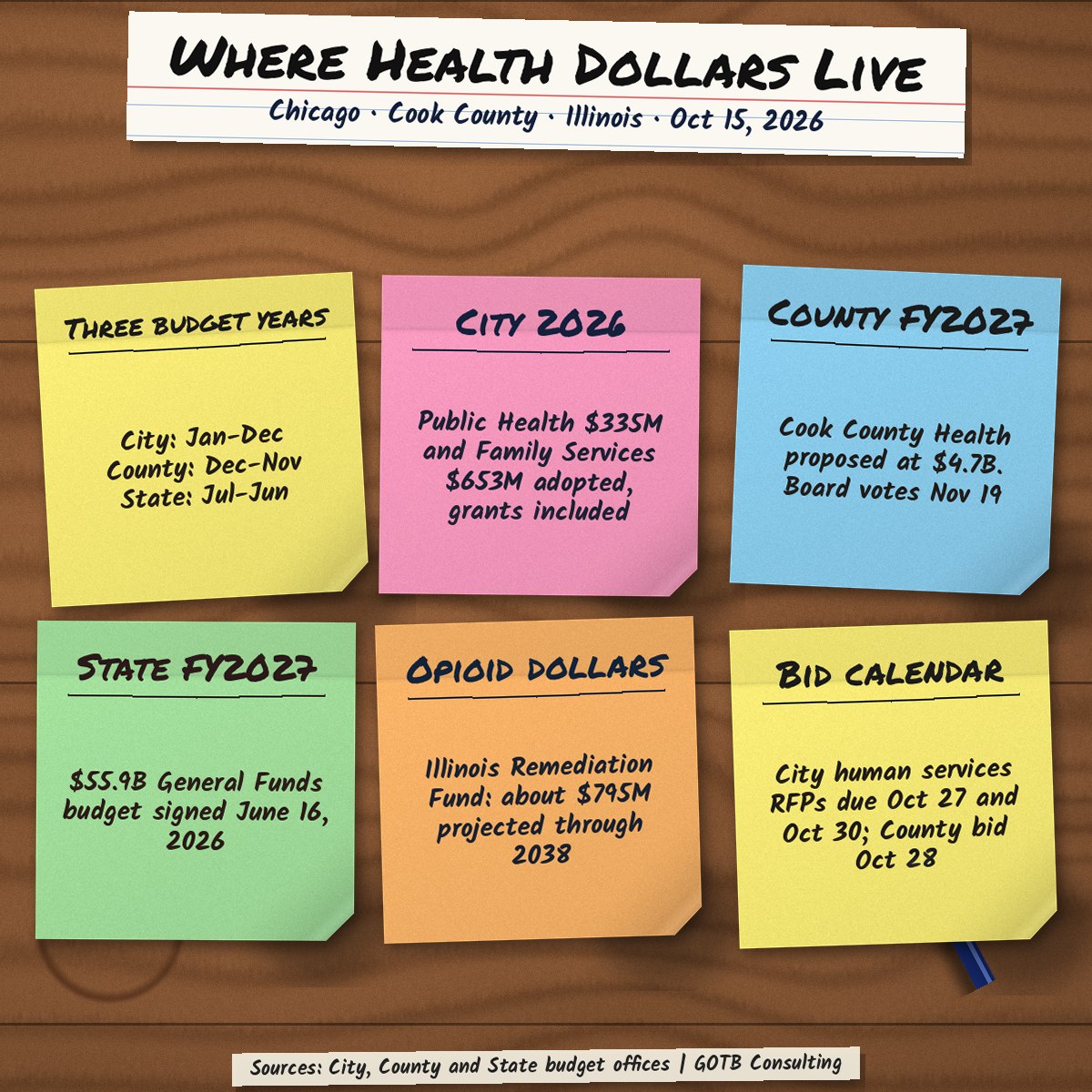
Health and human services money is not in one pot. It sits with different agencies at the City of Chicago, Cook County and the State of Illinois, each with its own budget year, its own buyer and its own front door. This page explains who controls what, how each one buys, and what is open right now. Facts are as of October 15, 2026, with a source link for each.

Think of it as three bus lines: City, County and State. Each runs on its own calendar and stops at its own station. Here is the route map, and the real posted dates for each stop.
1Who holds the money
Two departments, one buyer
Budget year: calendar year, Jan. 1 to Dec. 31
In plain words: The City does not have one health department. CDPH runs public health, DFSS runs human services, and DPS runs the buying rules for contracts. Much of the money is grant money from federal and state sources passing through City departments.
Names and titles as of Oct. 2026, from the City pages linked above.
One health system, one buyer office
Budget year: Dec. 1 to Nov. 30
In plain words: In the County, the health system is the big spender. Most of its money comes from patient care and the CountyCare health plan, not from taxes. The Board President proposes the budget and the Board of Commissioners votes on it.
Names and titles as of Oct. 2026, from the County pages linked above.
Three agencies and a procurement officer
Budget year: July 1 to June 30 (FY2027 began July 1, 2026)
In plain words: At the State, IDHS, IDPH and HFS decide what gets funded. A separate procurement office runs the bidding. State grants (called notices of funding opportunity, or NOFOs) follow a different path than State contracts.
Names and titles as of Oct. 2026, from the State pages linked above.
Leaders change. If a name matters to you, confirm it on the linked official page before you reach out.
2The budgets in plain numbers
City of Chicago
Cook County
State of Illinois
In plain words: City figures are the adopted appropriation, which includes grants. County figures are the FY2026 adopted and FY2027 proposed budgets. State agency figures are from the Governor’s February 2026 proposal, which the enacted FY2027 budget builds on; check the State budget book for final agency lines. Federal changes to Medicaid and grants are the main pressure at every level: the County expects about 330,000 Illinoisans to lose Medicaid coverage, and IDPH’s federal funds are projected to fall about 35%.
Sources: City Council Office of Financial Analysis, City 2027 forecast, County FY2027 Volume II, CCH budget presentation, State budget signing, State HHS budget presentation.
3How each one buys
Register once, then watch “current bids”
- Suppliers register in the City’s eProcurement (iSupplier) system before they can respond. Allow several days for approval.
- DPS posts bids and RFPs; CDPH and DFSS post their own funding RFPs too, mostly for not-for-profit delegate agencies, with some professional-services RFPs open to others.
- Pre-proposal webinars are not mandatory but are where scope questions get answered in public.
- The Vendor, Contract and Payment Search shows who holds City contracts and for how much.
Bonfire, plus a separate M/WBE list
- OCPO buys under the County Procurement Code, and vendors register in Bonfire to see and answer solicitations.
- The M/WBE directory is a separate system, so registering in one does not register you in the other.
- Cook County Health runs its own Bonfire portal for hospital-system buying.
- Bids often require economic disclosure and M/WBE utilization forms with the response.
BidBuy for contracts, GATA for grants
- Contracts: State agencies post bids on BidBuy, and vendors file disclosures through the Illinois Procurement Gateway.
- Grants: IDHS and IDPH issue NOFOs. Applicants register in the State grantee portal, prequalify, and need a SAM.gov unique entity ID.
- IDHS and IDPH award most grants through competitive review, and some programs are renewed rather than re-competed.
- The State’s Business Enterprise Program (BEP) has its own certification and utilization plans.
Contract or grant? It matters.
A contract buys something: a service, a supply, a study. A grant or delegate agency agreement funds a partner to run a program. Much of the health money moves by grant, and a lot of it moves through hubs and partners: a regional care coordination agency, a lead organization that re-grants microgrants, a health plan. That means teaming and subcontracting can matter as much as bidding as the prime.
4Opioid settlement channels
In plain words: Settlement money is a restricted pot, split among the State, a statewide fund, and local governments. It can only be used for approved opioid abatement: treatment, prevention, harm reduction and recovery. It is spent through its own channels, so each level has to be watched separately.
State: the Remediation Fund
Under the Illinois allocation agreement, 55% of settlement money goes to the Illinois Opioid Remediation Fund. IDHS’s Office of Opioid Settlement Administration runs it, the Illinois Opioid Remediation Advisory Board recommends uses, and the Governor’s steering committee approves them. The Fund had received $299 million as of June 1, 2026, and about $795 million is projected through 2038.
State: the regional hub
IDHS used a competitive NOFO for a single Regional Care Coordination Agency (about $10.9 million over three years, FY27 to FY29) that re-awards sub-grants across seven regions for prevention, treatment, recovery and harm reduction. Applications closed May 15, 2026. New sub-grant NOFOs are posted on the Initiative’s funding page.
City of Chicago
The Illinois Attorney General estimated Chicago would receive about $78 million over 18 years. CDPH uses it for harm reduction, linkage to care and treatment, recovery supports, public safety partnerships, outreach and data. Some 2026 CDPH contracts are funded this way, for example harm-reduction services of $425,000 through Dec. 31, 2026.
Source: City of Chicago, 2023 ↗ · Vendor, Contract and Payment Search ↗
Cook County
Cook County Health carries an Opioid Remediation and Abatement fund: $3.5 million adopted for FY2026 and $11.1 million recommended for FY2027, a jump of about $7.6 million.
5Bid calendar

I separate what is posted from what is only forecast, and I tag notices and budget dates differently from bids. Dates come from the official posting. Check the source and any addenda before you rely on a date.
Bid calendar last checked: October 16, 2026
Mayor's 2027 budget address
The Mayor is scheduled to present the City's FY2027 budget proposal to City Council. Departmental hearings follow, and Council must pass a balanced budget by December 31. The City's own forecast shows an $882.4 million gap for 2027.
Source: Chicago Tribune, Oct. 13, 2026 ↗Help Over Harm RFP (#77299)
A program for people who cause harm in relationships. DFSS expects to fund one to three agencies at $100,000 to $300,000 per year, for Jan. 1, 2027 to Dec. 31, 2029. Proposals are due by noon CT through the City's eProcurement system.
Source: DFSS posting, Sept. 16, 2026 ↗Autopsy Supplies (Ref. 2638-05270R)
An invitation for bid from the Cook County Medical Examiner. Bids go in through Cook County's Bonfire portal, with the County's economic disclosure and M/WBE utilization forms.
Source: Cook County Bonfire ↗Emergency extension notice: Patient Access and Care Optimization Study
IDPH posted a notice of a term-only extension of an existing consulting contract (estimated value unchanged) for a report due to the Governor and General Assembly by January 31, 2027. Posted for transparency; it is not a new competition.
Source: BidBuy 27-482DPH-DIREC-B-54474 ↗Out-of-School Time Programs RFP (#67226)
Youth programs for ages 6 to 21: $3.5 million for year-round programs and $10 million for project-based programs, with awards from $125,000 to $3.75 million. Term Jan. 1, 2027 to Dec. 31, 2029. Proposals are due by noon CT through eProcurement.
Source: DFSS posting, Sept. 18, 2026 ↗Emergency Notice Courier Services FY27
Statewide courier and logistics for medical supplies and vaccine deliveries, including temperature-controlled transport, priced as hourly rates. The bid opening shown on BidBuy is Nov. 14, 2026 at 3:20 p.m.
Source: BidBuy 27-482DPH-PREPD-B-53748 ↗Cook County Board vote on the FY2027 budget
The Board of Commissioners votes on the $9.69 billion Executive Budget Recommendation, which proposes Cook County Health at $4.7 billion. The County's fiscal year 2027 starts December 1.
Source: Cook County, Oct. 5, 2026 ↗Deadline for Council to pass the City's 2027 budget
The Council must approve a balanced budget by December 31. The City's fiscal year is the calendar year, so the 2027 budget takes effect January 1.
Source: Council Office of Financial Analysis ↗Community Wellness Microgrants, round 2 (expected)
CDPH said a second round of the $600,000 microgrant program is expected to open in January 2027. Applications run through the program's lead coordinating organization, not through the City portal.
Source: City of Chicago press release, Oct. 5, 2026 ↗Quiet lanes: nothing open right now
Cook County Health: nothing posted
The Cook County Health Bonfire portal showed no open opportunities on Oct. 15, 2026. New bids and RFPs are posted there.
Source: CCH Bonfire portal ↗IDHS and IDPH grants: none open
The 2026 competitive notices found on the IDHS and IDPH sites (including the $10.9 million opioid-settlement Regional Care Coordination Agency NOFO, closed May 15) have all passed their deadlines.
Source: IDHS NOFO: RCCA ↗Recently closed
- Oct 2 · City · DFSS · Professional Learning and Continuous Quality Improvement RFP (#67260) (closed). Source ↗
City and County portals are the official record, and dates can move by addendum. This calendar is a convenience, not a substitute for the solicitation documents.
6How to get in the lane

I’m Commons. Money moves where people show up early, so here are the six stops, in order.
Pick your lane
Decide whether you want to sell something (a contract), run a program (a grant or delegate agency), or support someone who does (a subcontract or teaming role).
Register where each buyer looks
City: eProcurement. County: Bonfire, and the M/WBE directory if eligible. State: Illinois Procurement Gateway and BidBuy for contracts, the grantee portal and SAM.gov for grants.
Get certified if you qualify
The City, County and State each run minority- and women-owned business programs with their own paperwork. Start early; approval takes time.
Learn the calendar
The three budget years do not line up. A request that is too late for one budget may be right on time for another.
Show up before the solicitation
Programs are shaped at budget hearings, advisory boards and public meetings. Once a solicitation posts, the scope is set and contact with staff is limited to the stated question window.
Read the solicitation closely and answer on time
Attend the pre-proposal webinar, submit written questions by the deadline, and file through the official portal. Late and emailed proposals are routinely rejected.
7Three calendars, one timeline
Orange marks the first month of each fiscal year and blue the last.
Calendar year
The Mayor proposes in the fall (this year, expected Oct. 21). Council holds hearings and must pass a balanced budget by Dec. 31. The year runs Jan. 1 to Dec. 31.
Dec. 1 to Nov. 30
The President presents in early October (Oct. 8 this year). The Board votes in November (scheduled Nov. 19). FY2027 starts Dec. 1, 2026.
July 1 to June 30
The Governor proposes in February (Feb. 18 this year). The General Assembly passes the budget in the spring, signed June 16 for FY2027. FY2027 started July 1, 2026.
Key dates
- Dec 19-20, 2025City Council adopts the FY2026 budget; it takes effect Jan. 1, 2026.
- Feb 18, 2026Governor’s FY2027 health and human services budget presentation.
- Jun 16, 2026Governor signs the $55.9B FY2027 General Funds budget; State FY2027 begins July 1.
- Jul 15, 2026City Council confirms Dr. Garth Walker as CDPH Commissioner; he starts Aug. 12.
- Oct 8, 2026Cook County unveils its $9.69B FY2027 budget recommendation.
- Oct 21, 2026Mayor scheduled to present the City’s FY2027 budget.
- Oct 27 to Nov 14, 2026Posted bids and RFPs close (see the bid calendar).
- Nov 19, 2026Cook County Board scheduled to vote on the FY2027 budget.
- Dec 1, 2026Cook County FY2027 begins.
- Dec 31, 2026Deadline for City Council to pass the 2027 budget.
- Jan 2027CDPH microgrant round 2 expected to open.
- Jul 1, 2027Illinois FY2028 begins.
8Sources
- City FY2026 budget: Council Office of Financial Analysis review (Jan. 2026)
- City of Chicago 2027 Budget Forecast (Sept. 2026)
- City 2027 Budget Engagement Report release (Oct. 13, 2026)
- Chicago Tribune: Mayor's budget address date (Oct. 13, 2026)
- CDPH leadership (Commissioner Walker)
- City Council confirms CDPH Commissioner (July 15, 2026)
- DFSS leadership (Commissioner Green)
- DPS leadership (Chief Procurement Officer Roberts)
- CDPH RFPs and grant opportunities
- DFSS funding opportunities
- City eProcurement (supplier registration)
- City Vendor, Contract and Payment Search
- City opioid settlement initiatives (Mar. 2023)
- Cook County FY2027 Executive Budget Recommendation release (Oct. 8, 2026)
- Cook County FY2027 Volume II: Department Line Item Budget
- Cook County Health FY2027 budget presentation (July 31, 2026)
- Cook County Department of Public Health leadership
- Cook County Office of the Chief Procurement Officer
- Cook County Health Bonfire portal
- Illinois FY27 budget signing (June 16, 2026)
- Illinois FY27 Enacted Budget Financial Walkdown (June 15, 2026)
- Illinois Health and Human Services FY27 budget presentation (Feb. 18, 2026)
- IDPH director (About IDPH)
- IDHS Office of the Secretary
- HFS Director
- Illinois CPO for General Services
- BidBuy (State of Illinois bids)
- Illinois Procurement Gateway (vendor registration)
- IDHS NOFO: Regional Care Coordination Agency
- Illinois Opioid Settlements Initiative: settlement information
- Illinois Opioid Settlements Initiative: funding opportunities
This page summarizes public budgets, official pages and public postings as of October 15, 2026. It is not an official government publication and not legal advice. Budgets, officials and solicitation dates change; confirm each item at the linked source before acting on it.
About
Meet Michael E. Brown
President and Managing Partner, GOTB Consulting, LLC · Chicago
Michael E. Brown has 20+ years of governmental and municipal consulting and lobbying experience. He was lead contract negotiator on the $8.5B O’Hare 21 program and the $800M O’Hare rail extension, and lead lobbyist and contract negotiator on the $400M Chicago Department of Water Management lateral redevelopment. (Dollar figures are program sizes, not GOTB fees.)
He has worked with the Illinois legislature and public officials on public-private partnership (P3) policy, and has consulted to the Cook County Commission on reducing duplicative administrative offices. He is a frequent speaker at governmental and municipal functions, focuses on good government and healthier social and economic solutions for safe, successful neighborhoods, lives in Chicago, and serves on the Board of the March of Dimes.
- M.S., Psychology (1997), University of Iowa
- B.S., Psychology (1995), University of Iowa
About
Meet Richard Butler
Partner, GOTB Consulting, LLC · Chicago
Richard (Rich) Butler is a partner at GOTB Consulting and a 38-year veteran of Chicago city government. From August 2019 to February 2020 he served as First Deputy Commissioner and Chief Administrative Officer of the Chicago Department of Aviation (CDA), responsible for day-to-day administration and operations of O’Hare and Midway, including finance, contracts, operations, legal, human resources, workforce development, concessions, real estate and vehicle services. CDA manages the two airports with a federally funded budget of $8.5 billion. (Dollar figures are budget and program sizes, not GOTB fees.)
Before that, Rich was First Deputy Procurement Officer at the City’s Department of Procurement Services and Chief Administrative Officer of the Chicago Park District, where he oversaw procurement, audit, finance, warehousing and general administrative services on an estimated annual budget of $385 million and established district-wide policies and procedures. His City career began at the Department of Aviation as Director of Contracts Administration, and he also served as General Superintendent of the Department of Streets and Sanitation.
He completed the Chicago Accounting and Purchasing System Training Program and the City of Chicago Executive Management Program, was a key team member on the design and implementation plan for the City’s new eProcurement system, and is a member of the National Institute of Governmental Purchasing and the Purchasing Management Association of Chicago. He has served on the board of the Chicago Municipal Employees Credit Union and on the US Communities board, representing the City of Chicago, and traveled to South Korea to represent Chicago in the Kotra Alliance to bridge contracting opportunities. A native of Englewood, he attended De La Salle High School.
- B.S., Northern Illinois University








Fictional characters from GOTB’s original stories. Real-world facts always link to public sources.