
Signs on Buildings and Roads: Chicago permits, step by step
Wall signs, projecting signs, awning signs, painted walls, roof signs, freestanding signs and billboards all need to clear the same City gates: the Department of Buildings (DOB), the Zoning review in Planning and Development, and, for some signs, the alderman, City Council, the public way and Landmarks. This page walks through who reviews what, how a permit is obtained, how to fix an existing permit, and how to bring a sign into compliance. Facts are as of October 15, 2026, each with a linked source. Anything we could not confirm is tagged Verify with DOB.

Think of a sign permit as a relay race. Zoning checks that the sign is allowed where it is going. Buildings checks that it is safe, wired right and properly built. Some signs also run through the alderman and City Council, and anything over the sidewalk runs through the public way office. Here is the whole route.
1The short version
Fees: DOB Sign Permits, DPD sign review. Council order and clearances: 13-20-68013-20-650. Inspections: 13-20-530. Timing is GOTB analysis of the City Data Portal Building Permits dataset, permit type “PERMIT – SIGNS”, issued Oct. 15, 2025 to Oct. 14, 2026: middle half of permits took 22 to 77 days, and 9 in 10 took 143 days or fewer. The Portal’s issue date is when the City found the permit ready to issue, subject to fee payment, and the figures include permits that waited on the applicant. DOB does not publish a promised review time for signs: Verify with DOB.
2Know your sign
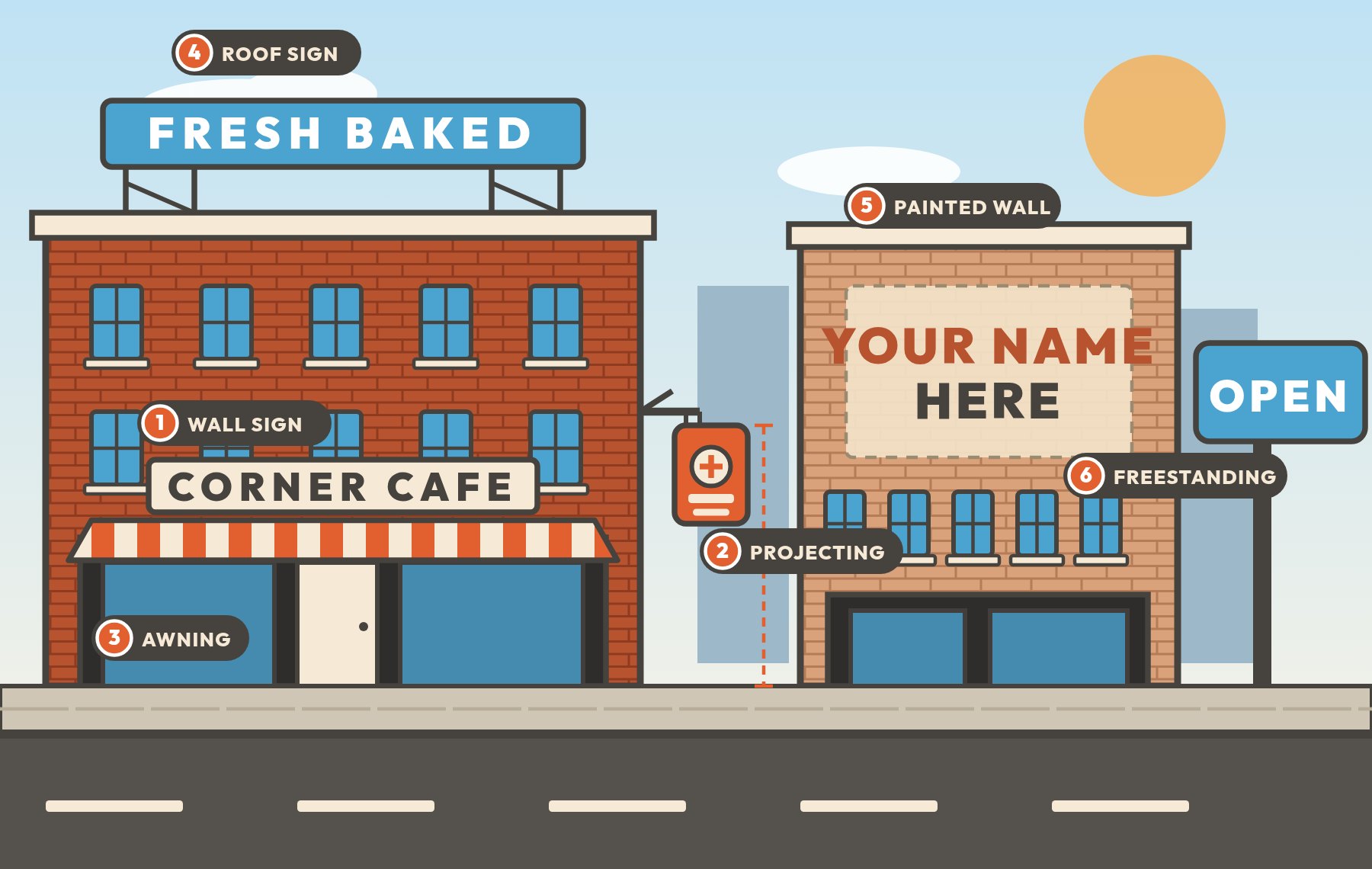
The code sorts signs two ways: by where it is attached (wall, projecting, roof, ground) and by what it says (on-premise advertises what is sold on site; off-premise advertises something else). The permit path depends on both.
Wall (flat) sign
Mounted flat against the building and parallel to it. In business, commercial, manufacturing and downtown districts wall signs are generally allowed by right, capped at 33% of the building wall area, and each ground-floor tenant is guaranteed at least 32 sq ft.
The code defines a flat sign as one placed flat against the building and parallel to it. How far it may stick out is stated two ways in the sources we read (12 inches in an older Part D text, 15 inches in the building code definitions): Verify with DOB
Painted wall sign
Paint applied directly to a building wall counts as a sign, and a sign permit and zoning review apply. The Michigan Avenue, Oak Street, Chicago River and Wrigley Field Adjacent special sign districts all ban painted wall signs (Michigan Avenue also bans applied vinyl signs).
A painted sign that predates the current rules may be a lawful nonconforming sign or, after 30 years, a candidate for vintage sign status. Both are covered below.
Projecting (blade) sign
Sticks out from the building at an angle or right angle. May project into the public way if set back at least 18 inches from the curb line, and needs 9 feet of clearance if it extends more than 12 inches over the public way. The building code adds that a projecting sign may be up to 70 feet high with a single face up to 250 sq ft.
Anything over the public way also needs a Public Way Use permit, which does not replace the DOB permit. Engineered drawings are required when the electrical code section 14E-6-600.28 calls for them.
Awning, canopy and marquee signs
A sign on an awning must be affixed flat to the awning surface, stay inside its edges and cannot be internally lit. An awning, canopy or marquee on or over the public way needs a Public Way Use permit, and that permit does not replace a DOB permit. Several special districts add limits on awning lettering size and lighting.
Roof sign
Erected on and supported by the roof. Roof signs are banned outright in the Michigan Avenue, Oak Street, State/Wabash and Chicago River special sign districts, and the zoning code’s general rules on prohibited signs also restrict them. The building code sets height and clearance limits: up to 60 feet above the roof, at least 5 feet of clear space under the face, and the face set back at least 6 feet from any wall fronting a public way.
The current zoning rule on roof signs outside those districts (17-12-0700 series): Verify with DOB
Freestanding (ground) sign
Supported by a structure standing on the ground. Total freestanding area is capped at 50% of the lot’s total sign area. The zoning height limit is 24 feet, or 35 feet on a lot with more than 75 feet of frontage on a street wider than 80 feet, or 50 feet with more than 150 feet of such frontage. Freestanding signs are prohibited on designated Pedestrian Streets.
The building code adds its own limits (open ground signs up to 60 ft; other ground signs up to 15 ft 6 in): how they interact with the zoning heights, Verify with DOB
Digital (dynamic image) sign
Any sign that changes by anything other than physically swapping the face. Dwell time, brightness and motion limits apply, and a permit application for a digital sign must include an affidavit. Zoning caps digital sign area at 25% of the lot’s total sign area or 64 sq ft, whichever is less (32 sq ft in B1 and B2 districts). Changing a static sign to a digital one needs a new permit and, where the sign had or needed a Council order, a new Council order.
High-rise building sign
Signs high on tall buildings follow their own rules: one sign per building (two for a qualifying headquarters tenant), individual letters only, sized by height (200 sq ft at 150 to 199 ft up to 1,100 sq ft at 800+ ft), business identification of the principal tenant only, and no projecting signs. Hotels and hospitals are allowed by right in DC, DX, B3, C3 and DS districts; other tall buildings there need a special use.
Off-premise sign (billboard or advertising sign)
A sign that advertises something not sold or offered on the same property. A permit is always required, the zoning fee is higher, and extra location rules apply: distance from homes, parks, waterways, expressways, other billboards, and no billboards in the Lakefront Protection District or on primary boulevards. Changing an on-premise sign to off-premise (or back) requires a new permit.
In plain words: a sign for the business that is in the building is an on-premise sign. A sign selling something elsewhere is an off-premise sign. A mural with no commercial message is generally not a sign for permit purposes (13-20-550(e)), but a mural with a commercial message is.
3Who does what at the City
Department of Buildings (DOB)
Issues sign permits, inspects signs when installed and at least every 24 months, enforces the sign code, and can suspend or revoke a permit. Licenses the general and electrical contractors who work on signs.
Planning and Development: Zoning Ordinance Administration
Reviews each sign for location, size, placement, setback, height and type under the Zoning Ordinance and approves or denies it through the DOB system. Collects the zoning review fee. Also issues zoning opinion and verification letters.
Historic Preservation Division (Landmarks)
Reviews permit applications for work on designated or proposed Chicago Landmarks and in landmark districts. Sign permit exceptions may not apply to landmark property, so check before ordering a sign.
Business Affairs and Consumer Protection (BACP): Public Way Use
Handles the Grant of Privilege / Public Way Use permit for any sign, awning, canopy or lighting that extends over the sidewalk, street, alley or parkway. BACP prepares the ordinance for City Council, and the alderman of the ward signs the application first.
Public Way Signs and Fixtures · Awning/canopy application (PDF) · 10-28-010
Chicago Department of Transportation (CDOT)
The contractor obtains CDOT permits to obstruct a street or sidewalk while a sign is built or serviced. Missing one can cost the contractor its sign permit privileges.
Alderman and City Council
A sign over 100 sq ft, or a roof or ground sign over 24 ft high, needs a City Council order in addition to the DOB permit. The applicant sends the alderman a duplicate application and an order template, and notifies registered voters within 250 ft, except for business-identification-only signs on the business premises.
Administrative Hearings, Building Board of Appeals, courts
Sign violations (including billboards) are heard in the Buildings Hearings Division. The Building Board of Appeals reviews permit-related decisions of the Commissioner, other than electrical. Final hearing orders go to Circuit Court on administrative review.
4Getting a permit, start to finish

I keep the order straight. Do not buy the sign first. Nine stops, in order; if a stop does not apply to your sign, skip it, but read the line first to make sure.
Confirm the sign is allowed where you want it
Look up the zoning district for the address on the City zoning map, then check the district’s sign rules: allowed types, total sign area, height, lighting, and any special sign district (Michigan Avenue, Oak Street, State/Wabash, Chicago River, Wrigley Field Adjacent). DOB says to check the code before ordering a sign, because not every sign is allowed. Check landmark status too.
Find out whether a permit is even required
Exempt work includes: signs inside a building seen only from that lot; official and legally required signs; non-commercial art murals (with a limited acknowledgement panel); qualifying window signs covering no more than 25% of a window; lettering all under 2 inches tall; Fast-Track Business Signs authorized by BACP; and temporary signs that meet the zoning rules. A building permit may still be needed for electrical work or a supporting structure, and exemptions may not apply on landmark property.
Line up who has to sign and who has to do the work
The application is made and signed by the owner or the tenant (lessee) of the property where the sign goes. A business can apply itself. If the sign needs engineered drawings under the electrical code (14E-6-600.28), it must be installed under a general contractor licensed in Chicago, whose name and license number go on the application. If the sign is digital, or lit directly or indirectly, a licensed electrical contractor must also sign. A licensed crane operator must run any crane hoisting a sign. Contractors may not lend their name or license number to a permit they are not performing.
DOB Sign Permits · 13-20-560(a)(1)13-20-57013-20-60113-96-040. An older BACP page says only a licensed sign contractor may apply; DOB’s page says a business may apply itself. Verify with DOB.
Start the application online and pay the zoning fee
Sign permits are started in the City’s older Permit Portal (not the newer Express Permit portal, which does not cover signs). Complete the online application, and pay the zoning review fee ($200 on-premise, $500 off-premise); DOB says to pay it online first. Each sign needs its own application. Print the completed online application.
Permit Portal login · E-Plan help: two portals · Express Permit Program. The City says plan-based permits are scheduled to move to the new portal in 2026; signs still pointed to the old one on Oct. 15, 2026. Verify with DOB for the current portal.
Assemble and submit the package
Complete the paper supplemental sign permit application, then deliver or mail it with the printed online application, an image or drawing of the sign, a site plan showing where it goes, any architectural or engineering drawings, and other supporting documents to DOB Sign Permits, City Hall, 121 N. LaSalle St., Room 900.
Supplemental Sign Permit Application (PDF, 2018 form). DOB’s own Sept. 29, 2026 FAQ still says to complete the supplemental paper application and mail it to DOB, while the City prioritizes electronic services and drop-off. Confirm the current method and form version: Verify with DOB. See DOB current operations FAQ.
Reviews and corrections
DOB and Zoning review the application. Requests for missing information, corrections and reasons for non-approval are noted in the online system where the applicant can see them in real time. If DOB finds the application deficient it must say so in writing; the applicant has 120 days to fix it or it is deemed withdrawn (extendable for good cause), and may petition to contest a deficiency.
Council order and public way, if triggered
If the sign is over 100 sq ft, or a roof or ground sign over 24 ft, file an order with the City Clerk (the alderman gets a duplicate application), mail notice to registered voters within 250 ft except for on-premise business-identification signs, and attend the committee hearing. The committee recommends approval or disapproval based on aesthetic fit, concentration of signs and public safety, never on the sign’s content. If the Council does not act within 60 days of the order being submitted, the order is deemed issued, but that clock does not start until a complete application is with both DOB and the alderman. DOB cannot take final action until the order issues. If any part of the sign or its lighting is over the public way, file the BACP Public Way Use application as well.
Approval, permit fee and installation
When every City approval is granted DOB emails the applicant, who then pays the permit fee and prints the permit. DOB’s FAQ says most application fees can be paid online, and other payments go to a Department of Finance Payment Center. Installing a sign that needs a permit before the permit is issued is subject to citation. The permit must be displayed at the site during installation. Off-premise signs must permanently display the permit number (and the public way permit number if any) where it is visible from the public way.
Inspection, then periodic re-inspection
The first inspection fee is included in the permit fee. DOB re-inspects permitted signs at least once every 24 months and more often based on risk, to check electrical and structural safety, with a separate inspection fee. If a sign is found out of compliance the Commissioner may order the electrical current cut off.
5Inside the department: how a sign application moves
Public pages describe the main reviews but not an official routing diagram. This is the sequence the published rules and DOB and DPD pages support.
Intake and zoning fee
The online application is started and the zoning review fee is paid online first, per DOB. A site plan is part of the package.
Zoning review (Planning and Development)
Zoning staff test the sign against the district: type, total sign area, wall percentage, height, lighting, setbacks, special sign district and off-premise separation rules. They approve or deny in the same online system. Corrections show up in the applicant’s account.
Building review (DOB)
DOB checks structure and construction, including wind load and materials, the sealed engineering drawings where required, the clearances and projections, and the electrical side for lit signs. Where the application is a plan-based permit, DOB routes drawings to several discipline reviewers at once (architectural, structural, electrical and others). How a sign application is routed between these reviewers is not published page by page: Verify with DOB.
Other City departments, when the sign calls for it
Historic Preservation for landmark property; BACP and the alderman for anything over the public way; the City Clerk and a Council committee for large signs; CDOT for street or sidewalk obstruction while it is built. DOB cannot take final action on a Council-order sign until the Council issues or is deemed to have issued its order.
Final approval and fee
When all approvals are in, the permit fee is calculated and the applicant is emailed. DOB’s FAQ notes that fees are paid online or at a Department of Finance Payment Center.
Inspection and the long tail
Installation is inspected; later, DOB re-inspects at least every 24 months. DOB can issue a notice of non-compliance or revoke the permit if the sign has changed, lost its permit number display, or been abandoned.
6Fees at a glance
Zoning review
Per sign application: $200 for an on-premise sign, $500 for an off-premise sign. Paid online when the application starts.
DOB building fee per face
By sign area: under 50 sq ft $50; 50 to 99 $100; 100 to 199 $200; 200 to 499 $500; 500 and up $1,000. Code text also describes a non-refundable review fee of half the permit fee, paid at filing, and deducted at issue; the 2022 fee tables list a separate stand-alone review fee. How the two combine on a sign application: Verify with DOB
Re-inspection fee
Each later inspection is $40 per sign, plus $1.00 per sq ft over 100 sq ft for flat, roof and private-property ground signs, or $1.50 per sq ft over 100 sq ft for signs projecting over the public way. Signs at places for eating follow a different section (4-8-042). The first inspection is included in the permit fee.
Administrative changes
A change of owner or contractor was $75 and a permit reprint $25 in the 2022 schedule. Extending or reinstating a permit costs 25% of the original permit fee. Fees are adjusted each January 1 for inflation, and DOB posted 2027 rates on Sept. 28, 2026: check the current schedule. Verify with DOB
Public way use
BACP issues the public way use permit. Fees are set in section 10-28-017; we did not confirm the amounts for signs, awnings or canopies: Verify with DOB
Fines for no permit
Violating the permit requirement for a static sign: $7,500 to $10,000 per offense, with lower tiers by sign size (from 200 to 499 sq ft per face: $2,000 to $5,000; 100 to 199: $1,000 to $2,000). Dynamic (digital) signs: $10,000 to $15,000. Each day is a separate offense. Smaller signs follow a different fine section whose amount we did not verify. Verify with DOB
Amounts are from the City pages and code sections linked on each card. Fees change; confirm the current figure with DOB before budgeting.
7Fixing problems with an existing permit
Information changed? Report it fast
Any substantial change from what the application said, including a new owner or lessee of the property or a new payer, must be reported to DOB within 10 days. If you learn that a permit application held false or inaccurate information, notify DOB in writing within 7 days. A permit issued on materially false information is void and the fee is forfeited.
Changing the sign changes the permit
“Alteration” includes relocating, re-erecting, raising or lowering, adding extensions, enlarging, switching on-premise to off-premise, switching static to digital, changing the address, and deviating from the approved drawings. Each one requires a new permit. Building contrary to the permit invalidates it.
Permit stalled or lapsed
Under the permit-limits section a permit is suspended if work does not start within 180 days. DOB can extend or reinstate up to two times before work starts, or four times after, in 180-day steps, capped at 720 days in total, for 25% of the original fee each. A permit is void and cannot be reinstated if work has not started within 540 days or has stopped for 730 days. DOB’s FAQ says to email the original permit number and address to its Express Permits mailbox for an extension or reinstatement; whether that route applies to signs: Verify with DOB
Application deficient
If DOB says in writing that an application is incomplete, you have 120 days to cure; after that it is deemed withdrawn. You can ask in writing for more time for good cause, or petition to contest the deficiency.
Permit revoked or rescinded
DOB may revoke a sign permit for: building or altering without a valid permit; work contrary to the permit; abandonment; failing to obtain or renew a required public way use permit; loss of nonconforming status; failing to display the permit number; or a false statement on an application. A permit voluntarily reported as abandoned can be revoked without further notice. DOB can rescind a permit issued in error. Continuing to display a sign after its permit is revoked draws the same per-day fines as having no permit. The procedure is set by DOB rule.
13-20-56513-20-63013-20-64513-20-520(a)(2) · DOL rules portal: Rescission or Revocation of Permits. The text of DOB’s revocation rule: Verify with DOB.
Disagree with a decision
The Building Board of Appeals hears appeals of permit-related decisions of the Commissioner (not electrical): a written appeal within 14 days of the supervisor’s decision. Violation cases go to the Buildings Hearings Division at Administrative Hearings; final orders can go to Circuit Court on administrative review (verify the filing deadline).
Building Board of Appeals · Buildings Hearings · DOAH: appealing a decision
In plain words: most permit problems are paperwork that went stale: a new owner or tenant who was never reported, a permit that lapsed before work started, a sign that was later changed. DOB has an administrative path for each, but a revoked permit means the sign is treated as unpermitted until it is cured.
8Bringing a sign into compliance
Start with the record
Search the address in the DOB records site to see permits, inspections and violations, and in the City Data Portal permit dataset (permit type “PERMIT – SIGNS”). A missing record is a finding to resolve, not proof that no permit exists: older records may be on paper or archive.
Search Building Department Records · Data Portal: Building Permits · DOB FOIA
Sign has a valid permit but does not match it
Deviating from the approved drawings invalidates the permit. Fix the sign to match, or file for the change as a new permit (and Council order, if now over the thresholds).
Sign was never permitted
Apply for the permit that should have been obtained. The permit fee carries a penalty added for work done without a permit, and the application must cover all the unauthorized work. While a sign is unpermitted, or its permit was revoked, the City will not issue other building permits, zoning approvals or a business license for that lot (13-20-625 has the exact scope).
Sign is older than the current rules (nonconforming)
A lawfully established sign that no longer fits the zoning rules may stay if kept safe and in good repair, and nonconforming status runs with the land, so a new tenant or owner does not lose it. Only a change of message or panel, and routine maintenance, keep that status; any other alteration ends it permanently. The owner carries the burden of proving the sign was lawful. A nonconforming on-premise sign is abandoned after 12 months if the property lost its business license or sat vacant, and an off-premise sign after 12 months unused or without a valid permit. A Zoning Opinion Letter ($150, up to 30 days) is the formal way to ask the Zoning Administrator how the ordinance applies.
Sign is 30 years old: vintage status
The zoning code has a vintage sign designation for older nonconforming signs: in place at least 30 years, a five-year term, applied for jointly with the property owner to the Zoning Administrator. The qualifying criteria and what the designation allows are in 17-15-0600: Verify with DOB before relying on this route.
Sign was abandoned
A sign is abandoned if it carries no copy for six consecutive months, advertises a business or product no longer at the building (or one without a required business license), has an inspection fee unpaid for six months, or lacks its required permit number display for six months. The owner or manager must tell DOB in writing within 10 days and remove it within 30 days, with fines of $500 to $2,000 for each offense, each day a separate offense. If a nonconforming sign’s structure is removed so it can no longer be displayed, it is treated as abandoned, and leftover footings or poles do not preserve its status or permit.
DOB sends a notice of non-compliance
For an unsafe or non-compliant sign DOB can issue a written notice to the responsible person (the permittee for older permits; the property owner or tenant for permits since May 19, 2012; or the person in control of the sign) with a time to fix it, after which the permit can be revoked. If the responsible person cannot be found, a notice is posted on the sign and after 30 days DOB can have the sign torn down. Costs fall on the owner, tenant and person in control, jointly, and the City can record a lien against the property.
Needs a variation or different design
If a sign cannot meet the zoning standards, the options are redesign, a zoning variation (17-13-1100), or a Council order where the sign is large enough to trigger one. Verify with DOB on whether a variation is available for the specific standard involved.
9Pitfalls that cost money
Responsibility is shared
The owner of the property, the tenant, whoever sells the ad space, whoever advertises on the sign, and the general and electrical contractors are all jointly liable if a sign lacks a valid permit. Anyone who profits from leasing space on an unlawful sign can be made to give up the revenue.
13-20-550, 13-20-520(d)
Buy after you permit
Ordering or installing before the permit is issued is subject to citation, and not every sign is allowed in every district.
DOB Sign Permits
One sign, one application, one active permit
Each sign needs its own application. DOB will not accept a new sign permit if a current valid sign permit already exists for that location, so old permits must be resolved first.
13-20-560(a)(3)(C)
Public way lapses sink the DOB permit
If a required public way use permit is never obtained or is not renewed on time, DOB may revoke the sign permit.
13-20-555, 13-20-565
Contractors can lose their privileges
A contractor that works without the permit, lends its license number to someone else’s job, or skips the CDOT obstruction permit can be suspended or lose its license.
13-20-520(b), 13-20-601, 13-20-690
Landmarks are different
On a landmark or in a landmark district, the usual exemptions may not apply and the Landmarks review comes first.
DOB guide: Signs
Special sign districts
Michigan Avenue, Oak Street, State/Wabash, Chicago River and Wrigley Field Adjacent have their own area, material, lighting and prohibited-sign lists.
17-12-1100
Cranes and rigging
A crane hoisting a sign or sign component must be run by a licensed crane operator.
13-96-040(e)
10Recent changes to watch
Section 13-20-550 amended
The history line on the permit-required section shows a City Council amendment dated June 17, 2026. We could not identify what changed. Verify with DOB before relying on older summaries of the permit-required rules.
Wrigley Field Adjacent sign district amended
The special sign district provisions (17-12-1105) show a June 17, 2026 amendment. Relevant only to properties in that district.
Residential-district sign text amended
Section 17-12-0900 was amended September 25, 2025. Its current text includes a rule allowing a sign, including a digital sign, at a Chicago Public Schools zoning lot, with size and brightness limits.
Permit portal move planned
The City’s help page says plan-based permits are scheduled to move to the newer Permit Portal in 2026. DOB’s Sept. 29, 2026 FAQ still describes sign permits as started online and completed with a mailed supplemental paper application. The newer Express Permit Program does not cover signs.
E-Plan help · Express Permit Program. Verify with DOB.
2027 fee rates posted
DOB posted CPI-adjusted building permit fee rates that apply from January 1, 2027. The sign fees DOB lists today match the 2022 table, and we did not confirm the 2027 sign amounts: Verify with DOB.
11Key code sections
13-20-500 to 13-20-780
Chapter 13-20, Article XIII: signs, billboards, signboards and related structures. Definitions, penalties, inspections, permits, limits, abandonment and removal.
13-20-550 · 13-20-555
When a sign permit and a public way use permit are required, who is responsible, and exemptions.
13-20-560 to 13-20-645
Application rules, changes of information, permit term and revocation, drawings, limits, display of permits, rescission.
13-20-680
City Council order for signs over 100 sq ft or roof and ground signs over 24 ft.
13-20-730 to 13-20-770
Notice of non-compliance, posting, demolition, abandoned signs and structures, removal.
13-96, Articles I and II
Outdoor signs and electric signs: definitions, construction, heights, abandonment reporting.
14E-6-600
Electrical code for signs and outline lighting, including engineered drawings (600.28). Cited by DOB.
14A-4-412 · 14A-4-413
Permit fees, penalties for unpermitted work, limitations, suspension, expiration, revocation.
17-12-0900 to 17-12-1100
Zoning rules for signs: allowed types, area, height, lighting, special sign districts, off-premise separation.
10-28-010 · 10-28-017
Public way use permit for any sign on, over or under the public way, and its fees.
10-24
Signs extending over and upon the public way (cited by DOB; text not reviewed for this page).
12Portals, forms and contacts
DOB Sign Permits ↗
Start here for requirements, fees and exemptions.
Permit Portal (older) ↗
Where sign permit applications are started and tracked.
Supplemental Sign Permit Application ↗
Paper form that goes with the printed online application (2018 version).
Building Permit Application Status ↗
Check a pending application by address or 9-digit number.
Search Building Department Records ↗
Permits, inspections and violations by address.
Data Portal: Building Permits ↗
Daily-updated dataset of issued permits since 2006, including sign permits.
DOB FOIA ↗
For records not online. DOBfoia@cityofchicago.org.
BACP Public Way Use ↗
Grant of Privilege for signs, awnings and canopies over the public way.
Landmark Permit Review ↗
Historic Preservation Division. landmarks@cityofchicago.org, 312.744.3200.
Office of the Zoning Administrator ↗
Zoning opinion and verification letters ($150 filing fee). DPD_Zoning@cityofchicago.org, (312) 744-5777.
Building Board of Appeals ↗
Permit-related appeals, 14-day filing window.
Buildings Hearings (DOAH) ↗
Hearings on building and zoning (billboard) violations. 312.742.8254.
Questions about whether a permit is needed: dob-info@cityofchicago.org or the DOB 9th-floor front desk at City Hall for general questions and document drop-off; applications are not processed on a walk-in basis (DOB current operations FAQ). Portal help: eplan@cityofchicago.org, (312) 744-9158 (E-Plan help).
13Could not verify: confirm with DOB
We checked the official sources linked on this page. These items could not be confirmed there, so treat them as open questions rather than facts.
- Verify with DOB Current DOB review time for signs and the order in which Zoning, structural and electrical reviewers see a sign application.
- Verify with DOB Whether sign applications have moved to the newer Permit Portal, and whether paper submission to Room 900 is still required.
- Verify with DOB Who may legally apply: DOB says a business or owner may apply and lists when a general contractor is needed; an older BACP page says only a licensed sign contractor may apply. Also whether a separate sign-hanger or sign-erector license is still issued (13-20-520(b) still refers to a registered sign contractor or bonded sign erector).
- Verify with DOB How the code review fee (half the permit fee) and the $25 stand-alone review fee in the 2022 fee tables fit together for signs, and the current inflation-adjusted amounts.
- Verify with DOB Fine amount for signs under 100 sq ft per face (set by section 14A-3-302.1, not reviewed).
- Verify with DOB The text of DOB’s rules on rescission and revocation of sign permits, including notice and any hearing step (13-20-645).
- Verify with DOB What changed in section 13-20-550 on June 17, 2026.
- Verify with DOB The zoning rule on roof signs outside the special districts (17-12-0700 series, not reviewed), the flat-sign projection limit (12 inches in an older Part D text, 15 inches in 13-96-030), and how building-code ground-sign heights fit with zoning heights.
- Verify with DOB BACP public way use annual fees for signs, awnings and canopies.
- Verify with DOB Whether an administrative or ZBA variation is available for a particular sign standard.
- Verify with DOB Filing deadline for Circuit Court administrative review of a hearing order.
14Sources
- DOB: Sign Permits
- DOB Guide to Building Permits: Signs (permit not required)
- Public Way Signs and Fixtures
- BACP Awning/Canopy Permit Application (PDF)
- Municipal Code 13-20 Art. XIII, Parts A and B (definitions, penalties, inspections)
- Municipal Code 13-20-550 to 13-20-620 (permits)
- Municipal Code 13-20-680 to 13-20-780 (Council order, abandonment, removal)
- Municipal Code 13-96 Art. I (outdoor signs)
- Municipal Code 10-28 (structures on public ways)
- Zoning Ordinance 17-12-0900 to 17-12-1100 (signs)
- Zoning Ordinance 17-15 (nonconformities and vintage signs)
- Excerpts of Chicago Construction Codes: permit fees (2022 PDF)
- DPD: Signs, on-premise and off-premise
- DOB Express Permit Program
- E-Plan: How it works
- E-Plan: Get Help
- Inspection, Permitting and Licensing Portal
- Building Permit Application Status
- Search Building Department Records
- DOB FOIA
- City Data Portal: Building Permits
- Landmark Permit Review
- Office of the Zoning Administrator
- Building Board of Appeals
- Buildings Hearings Division
- DOAH: Appealing a decision
- DOL rules portal: Rescission or Revocation of Permits
- DOB: Current Operations FAQ (Sept. 29, 2026)
- DOB: 2027 Fees alert (Sept. 28, 2026)
- Building Permit Search (Issued Permits), Data Portal story
This page summarizes public City of Chicago pages and Municipal Code text as of October 15, 2026. It is not an official government publication and not legal advice. Fees, rules and portals change, and permit decisions are made by the City. Confirm each item at the linked source or with the Department of Buildings before acting on it.

About
Meet Michael E. Brown
President and Managing Partner, GOTB Consulting, LLC · Chicago
Michael E. Brown has 20+ years of governmental and municipal consulting and lobbying experience. He was lead contract negotiator on the $8.5B O’Hare 21 program and the $800M O’Hare rail extension, and lead lobbyist and contract negotiator on the $400M Chicago Department of Water Management lateral redevelopment. (Dollar figures are program sizes, not GOTB fees.)
He has worked with the Illinois legislature and public officials on public-private partnership (P3) policy, and has consulted to the Cook County Commission on reducing duplicative administrative offices. He is a frequent speaker at governmental and municipal functions, focuses on good government and healthier social and economic solutions for safe, successful neighborhoods, lives in Chicago, and serves on the Board of the March of Dimes.
- M.S., Psychology (1997), University of Iowa
- B.S., Psychology (1995), University of Iowa
About
Meet Richard Butler
Partner, GOTB Consulting, LLC · Chicago
Richard (Rich) Butler is a partner at GOTB Consulting and a 38-year veteran of Chicago city government. From August 2019 to February 2020 he served as First Deputy Commissioner and Chief Administrative Officer of the Chicago Department of Aviation (CDA), responsible for day-to-day administration and operations of O’Hare and Midway, including finance, contracts, operations, legal, human resources, workforce development, concessions, real estate and vehicle services. CDA manages the two airports with a federally funded budget of $8.5 billion. (Dollar figures are budget and program sizes, not GOTB fees.)
Before that, Rich was First Deputy Procurement Officer at the City’s Department of Procurement Services and Chief Administrative Officer of the Chicago Park District, where he oversaw procurement, audit, finance, warehousing and general administrative services on an estimated annual budget of $385 million and established district-wide policies and procedures. His City career began at the Department of Aviation as Director of Contracts Administration, and he also served as General Superintendent of the Department of Streets and Sanitation.
He completed the Chicago Accounting and Purchasing System Training Program and the City of Chicago Executive Management Program, was a key team member on the design and implementation plan for the City’s new eProcurement system, and is a member of the National Institute of Governmental Purchasing and the Purchasing Management Association of Chicago. He has served on the board of the Chicago Municipal Employees Credit Union and on the US Communities board, representing the City of Chicago, and traveled to South Korea to represent Chicago in the Kotra Alliance to bridge contracting opportunities. A native of Englewood, he attended De La Salle High School.
- B.S., Northern Illinois University








Fictional characters from GOTB’s original stories. Real-world facts always link to public sources.