
Dark GPUs?
A clip going around replays remarks that the biggest AI risk is “dark GPUs,” idle chips like the dark fiber left after the dot-com crash, and that local pushback on data centers makes that glut less likely. On infrastructure programs, idle capacity usually means power, permits or schedule were not ready. This brief checks the claim against three sources.
As of October 16, 2026. Every figure below was checked against its source, and anything we could not verify is labeled.
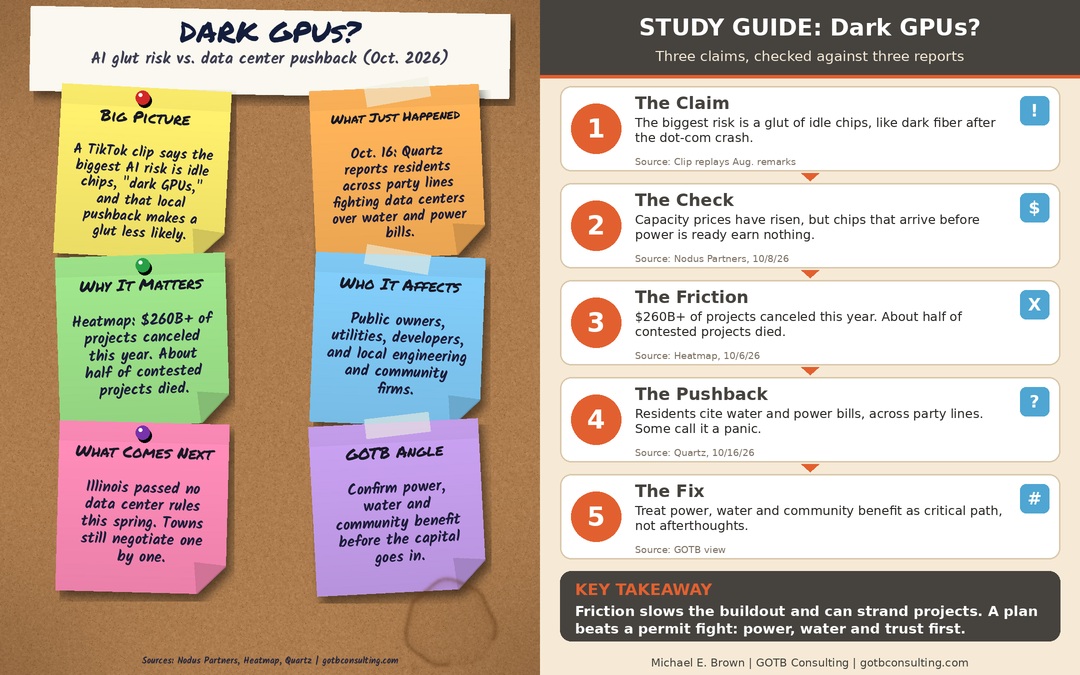
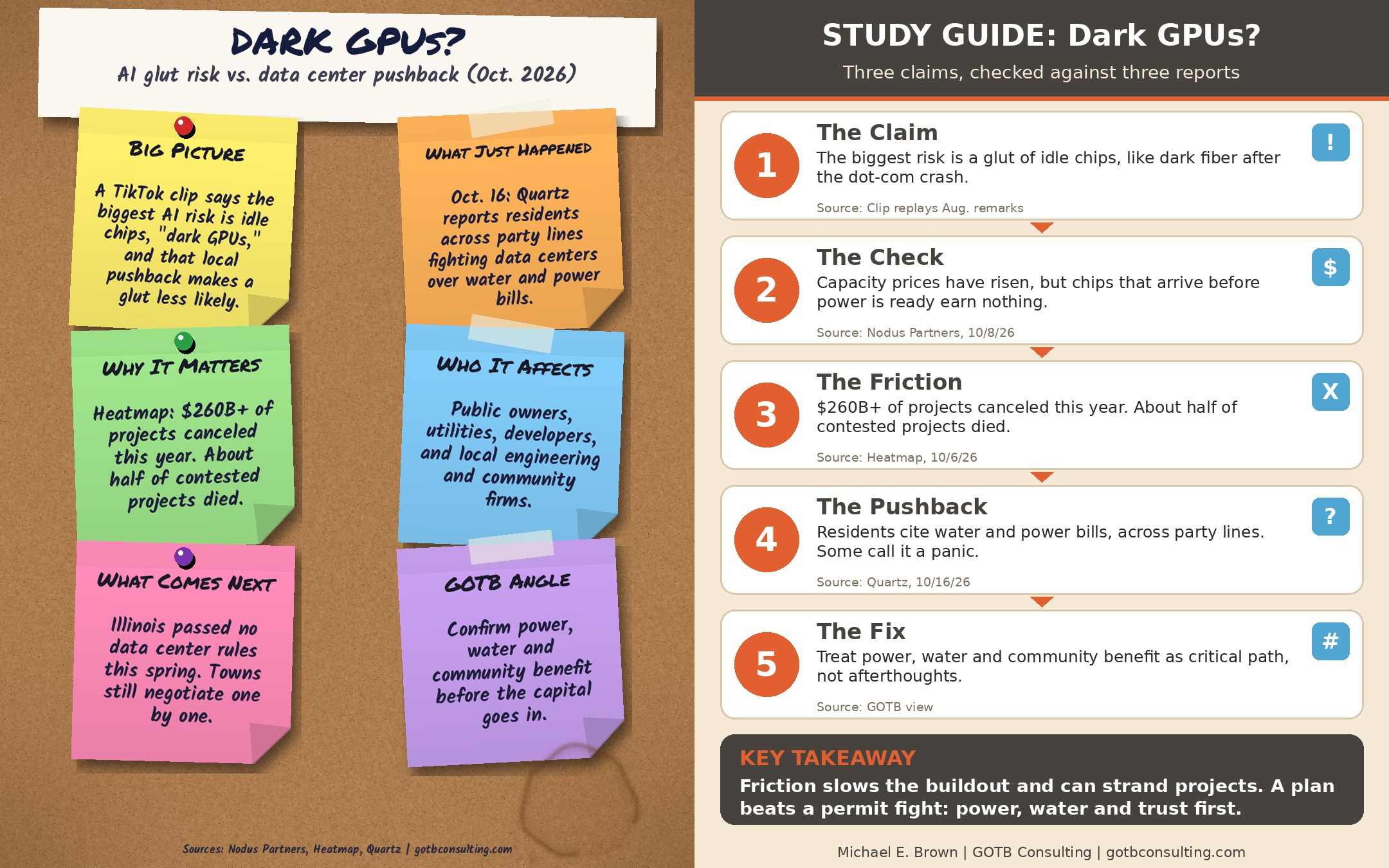
Read the text version of the graphic
Sticky notes.
- Big Picture: A TikTok clip says the biggest AI risk is idle chips, "dark GPUs," and that local pushback makes a glut less likely.
- What Just Happened: Oct. 16: Quartz reports residents across party lines fighting data centers over water and power bills.
- Why It Matters: Heatmap: $260B+ of projects canceled this year. About half of contested projects died.
- Who It Affects: Public owners, utilities, developers, and local engineering and community firms.
- What Comes Next: Illinois passed no data center rules this spring. Towns still negotiate one by one.
- GOTB Angle: Confirm power, water and community benefit before the capital goes in.
Study guide.
- The Claim: The biggest risk is a glut of idle chips, like dark fiber after the dot-com crash. (Clip replays Aug. remarks)
- The Check: Capacity prices have risen, but chips that arrive before power is ready earn nothing. (Nodus Partners, 10/8/26)
- The Friction: $260B+ of projects canceled this year. About half of contested projects died. (Heatmap, 10/6/26)
- The Pushback: Residents cite water and power bills, across party lines. Some call it a panic. (Quartz, 10/16/26)
- The Fix: Treat power, water and community benefit as critical path, not afterthoughts. (GOTB view)
Key takeaway. Friction slows the buildout and can strand projects. A plan beats a permit fight: power, water and trust first.
The numbers
Heatmap’s tally is its own count from public records and local media, and it says the figure is likely an undercount. Details and limits are below.
What the three sources say
Capacity is scarce, but delivery is the risk
Nodus Partners, an advisory firm in the GPU market, says demand for training and increasingly inference has absorbed new supply, large buyers are purchasing factory output years ahead, and the price of capacity has risen. Its warning is a familiar one: GPUs that arrive before power and cooling are ready “earn nothing while financing costs run.”
Source: Nodus Partners, Oct. 8, 2026Opposition is real, and it works
Heatmap says at least $260 billion of data center investment was canceled this year after sustained local opposition, and that about half of projects that met local backlash were ultimately canceled. Most cancellations followed failed local permits or hostile local government action. The largest tech companies are still expected to spend more than $800 billion.
Source: Heatmap, Oct. 6, 2026Specific worries, across party lines
Quartz reports residents are worried about higher water and power bills, and says the opposition crosses party lines. It also reports that Illinois lawmakers failed to pass any rules for data centers this spring, leaving each town to negotiate with developers on its own.
Source: Quartz, updated Oct. 16, 2026Reading it fairly
Commercial interests everywhere
Nodus advises on GPU allocation and has a commercial interest, and its figures are second-hand. Heatmap’s tally is its own and likely an undercount, and only about 60% of projects disclose their size. Both can be useful, and neither is a full picture.
Source: Nodus; HeatmapA glut risk and a delivery risk
Capacity can be scarce today and still be stranded tomorrow if power, water or permits fall through. The two sources describe different parts of the same problem.
Deserve specific answers
Worries about water and power bills are specific. Developers and public owners can answer them with specific commitments, in writing, before the capital goes in.
Source: QuartzWhat this means for public owners and local firms
- Confirm power first. Get utility commitments for capacity and timing before committing capital.
- Confirm water. Document cooling and water supply, and who pays for any upgrades.
- Show the community benefit. Put local benefits and a clear plan in writing before a rezoning request.
- Write it into procurement. Public owners can make these confirmations conditions of award.
- Think local. Certified small and local firms in engineering, commissioning and community engagement are worth watching.
What we could not verify
- Whether a glut is coming. We make no forecast. The sources disagree about how much risk there is.
- The tally. Heatmap says its $260 billion figure is likely an undercount and that only about 60% of projects disclose their size.
- The remarks in the clip. We did not verify the clip or the remarks as quoted. Only the three sources above are used for facts.
- Illinois detail. The Illinois statement is Quartz’s reporting. We did not check the legislature’s records.
- Prices. We do not rely on the GPU price figures that Nodus cites second-hand.
Sources, checked on October 16, 2026
- Nodus Partners, “GPU capacity in 2026: contracted, scarce and repricing” (Oct. 8, 2026)
- Heatmap, “Exclusive: Data Center Cancellations Top $260 Billion in 2026” (Oct. 6, 2026)
- Quartz, “Americans are packing town halls to stop data centers. It’s working, for now” (updated Oct. 16, 2026)
What is ours. The plain-words boxes and the points on contracts and procurement are GOTB’s interpretation, labeled as such. Everything else is quoted or counted from the sources above.
Claims and findings. This brief summarizes an advisory firm, a news outlet’s data tally and a news report. It contains no financial or investment commentary and takes no side in any local dispute.
This page is general information, not legal, engineering, security or investment advice, and it does not promote any product or company. Figures are as reported by the sources linked, as of October 16, 2026.

About
Meet Michael E. Brown
President and Managing Partner, GOTB Consulting, LLC · Chicago
Michael E. Brown has 20+ years of governmental and municipal consulting and lobbying experience. He was lead contract negotiator on the $8.5B O’Hare 21 program and the $800M O’Hare rail extension, and lead lobbyist and contract negotiator on the $400M Chicago Department of Water Management lateral redevelopment. (Dollar figures are program sizes, not GOTB fees.)
He has worked with the Illinois legislature and public officials on public-private partnership (P3) policy, and has consulted to the Cook County Commission on reducing duplicative administrative offices. He is a frequent speaker at governmental and municipal functions, focuses on good government and healthier social and economic solutions for safe, successful neighborhoods, lives in Chicago, and serves on the Board of the March of Dimes.
- M.S., Psychology (1997), University of Iowa
- B.S., Psychology (1995), University of Iowa
About
Meet Richard Butler
Partner, GOTB Consulting, LLC · Chicago
Richard (Rich) Butler is a partner at GOTB Consulting and a 38-year veteran of Chicago city government. From August 2019 to February 2020 he served as First Deputy Commissioner and Chief Administrative Officer of the Chicago Department of Aviation (CDA), responsible for day-to-day administration and operations of O’Hare and Midway, including finance, contracts, operations, legal, human resources, workforce development, concessions, real estate and vehicle services. CDA manages the two airports with a federally funded budget of $8.5 billion. (Dollar figures are budget and program sizes, not GOTB fees.)
Before that, Rich was First Deputy Procurement Officer at the City’s Department of Procurement Services and Chief Administrative Officer of the Chicago Park District, where he oversaw procurement, audit, finance, warehousing and general administrative services on an estimated annual budget of $385 million and established district-wide policies and procedures. His City career began at the Department of Aviation as Director of Contracts Administration, and he also served as General Superintendent of the Department of Streets and Sanitation.
He completed the Chicago Accounting and Purchasing System Training Program and the City of Chicago Executive Management Program, was a key team member on the design and implementation plan for the City’s new eProcurement system, and is a member of the National Institute of Governmental Purchasing and the Purchasing Management Association of Chicago. He has served on the board of the Chicago Municipal Employees Credit Union and on the US Communities board, representing the City of Chicago, and traveled to South Korea to represent Chicago in the Kotra Alliance to bridge contracting opportunities. A native of Englewood, he attended De La Salle High School.
- B.S., Northern Illinois University








Fictional characters from GOTB’s original stories. Real-world facts always link to public sources.