
Robots Meet the Job Site
Robots could technically do about three-quarters of the physical work done in the United States, yet they are cost-competitive for only 0.3% of it, roughly 300,000 jobs. That is the headline of a study by Anthropic’s economists, covered by Facilities Dive. On airport, rail and water work, a job site is not a factory floor: the ground changes daily and the thing you hit with a shovel might be a live utility. This brief reads the study next to the workforce data.
As of October 16, 2026. Every figure below was checked against its source, and anything we could not verify is labeled.
Read the text version of the graphic
Sticky notes.
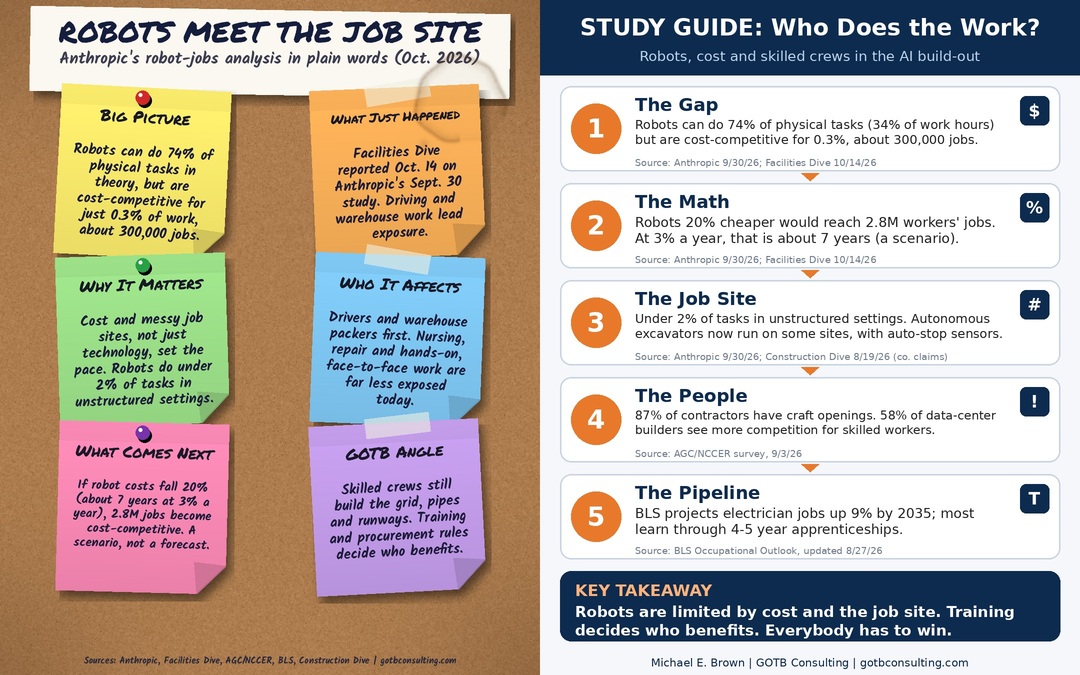
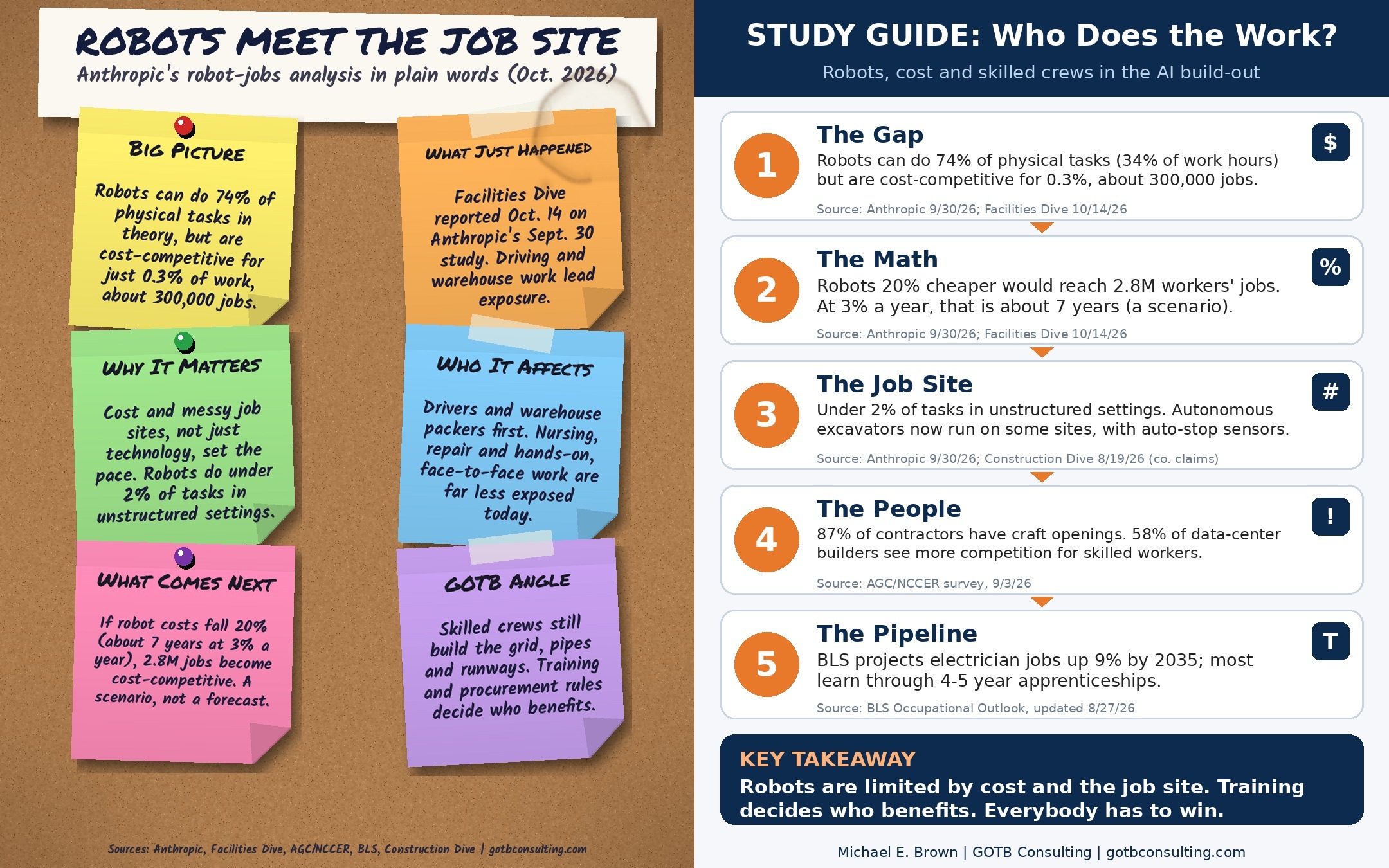
- Big Picture: Robots can do 74% of physical tasks in theory, but are cost-competitive for just 0.3% of work, about 300,000 jobs.
- What Just Happened: Facilities Dive reported Oct. 14 on Anthropic's Sept. 30 study. Driving and warehouse work lead exposure.
- Why It Matters: Cost and messy job sites, not just technology, set the pace. Robots do under 2% of tasks in unstructured settings.
- Who It Affects: Drivers and warehouse packers first. Nursing, repair and hands-on, face-to-face work are far less exposed today.
- What Comes Next: If robot costs fall 20% (about 7 years at 3% a year), 2.8M jobs become cost-competitive. A scenario, not a forecast.
- GOTB Angle: Skilled crews still build the grid, pipes and runways. Training and procurement rules decide who benefits.
Study guide.
- The Gap: Robots can do 74% of physical tasks (34% of work hours) but are cost-competitive for 0.3%, about 300,000 jobs. (Anthropic 9/30/26; Facilities Dive 10/14/26)
- The Math: Robots 20% cheaper would reach 2.8M workers' jobs. At 3% a year, that is about 7 years (a scenario). (Anthropic 9/30/26; Facilities Dive 10/14/26)
- The Job Site: Under 2% of tasks in unstructured settings. Autonomous excavators now run on some sites, with auto-stop sensors. (Anthropic 9/30/26; Construction Dive 8/19/26 (co. claims))
- The People: 87% of contractors have craft openings. 58% of data-center builders see more competition for skilled workers. (AGC/NCCER survey, 9/3/26)
- The Pipeline: BLS projects electrician jobs up 9% by 2035; most learn through 4-5 year apprenticeships. (BLS Occupational Outlook, updated 8/27/26)
Key takeaway. Robots are limited by cost and the job site. Training decides who benefits. Everybody has to win.
The numbers
The 2.8 million figure often quoted is a scenario, not a forecast: if robot costs fell 20%, robots would be cost-competitive for the physical work of about 2.8 million workers. Details and limits are below.
What the study found
Possible is not practical
Anthropic’s economists rated physical job tasks across the U.S. economy by whether a robot could do them today. Robots could perform 74% of physical tasks, but mostly in controlled settings like assembly lines. Robots that can work in structured workplaces such as warehouses can do about 22% of physical tasks. Robots that can work in unstructured settings, which include construction sites and city streets, can do only about 2%.
Source: Anthropic, Sept. 30, 2026; Facilities Dive, Oct. 14, 2026Cost sets the pace
The study compares estimated robot costs with worker pay. For packers, a robot system equal to 14 workers costs about $2 million plus $45,000 a year to run and, over a 10-year life, comes out cheaper than the workers. For welders it estimates robots cost about five times more than people. At the historical decline of roughly 3% a year, a 20% cost drop would take about seven years.
Source: Anthropic; Facilities DiveCareful hands around buried utilities
Anthropic estimates that about 20% of “dig trenches” work is careful hand digging around buried pipes, cables and conduit, which robots cannot do today. Autonomous excavators are working on some U.S. sites, including a water treatment facility, and the company says they stop if a person gets too close. Those are company statements, not independent test results.
Source: Anthropic; Construction Dive, Aug. 19, 2026The people side
Crews are already hard to find
In a survey of 1,830 people, AGC and NCCER found 87% of firms have craft openings and 88% of those say the jobs are as hard or harder to fill than a year ago. Among firms that built data centers, 58% say those projects increased competition for skilled workers. This is an industry association’s survey.
Source: AGC/NCCER, Sept. 3, 2026Apprenticeships take years
The Bureau of Labor Statistics projects electrician employment to grow 9% from 2025 to 2035, against 3% for all occupations, with about 72,700 openings a year. Most electricians learn through four- or five-year apprenticeships. BLS ties part of the growth to AI and data-center electricity demand and the grid upgrades it requires.
Source: BLS Occupational Outlook HandbookCost parity is not unemployment
The authors note that cost parity does not necessarily mean high unemployment, and that AI-powered robots could leapfrog their scale. The task ratings were produced with Anthropic’s own AI model, and the cost estimates are described as approximate.
Source: AnthropicWhat this means for public projects
- Fund the pipeline. Apprenticeship funding and career and technical education build the crews that sites need.
- Reward training. Procurement rules that reward local hiring, safety records and training commitments can turn automation into better jobs. This point is GOTB’s view, not a finding of these sources.
- Pilot safely. If an owner pilots automation on site, define stop conditions, utility locating and who is accountable.
- Upskill current crews. New tools still need people who know the ground, the drawings and the live utilities.
- Everybody has to win. Workers, owners, communities and technology firms all benefit when the build-out has the people to finish it.
What we could not verify
- Task ratings. Anthropic says the ratings were produced with its own AI model, and its cost estimates are approximate. We report them as the study’s estimates.
- The 2.8 million figure. It is a scenario, not a forecast, and we do not present it as one.
- Autonomous excavators. The safety and performance statements are the company’s, as reported by Construction Dive, not independent tests.
- The AGC/NCCER survey. It is an industry association’s survey of its own members and partners.
- Procurement effects. None of these sources measures procurement directly. That part is our view from public work.
Sources, checked on October 16, 2026
- Anthropic, “What work can robots do?” (Sept. 30, 2026)
- Facilities Dive, “Robots can handle a third of physical jobs — but not yet cost-effectively: Anthropic” (Oct. 14, 2026)
- AGC of America and NCCER, 2026 workforce survey release (Sept. 3, 2026)
- U.S. Bureau of Labor Statistics, Occupational Outlook Handbook: Electricians (updated Aug. 27, 2026)
- Construction Dive, “Bedrock Robotics deploys fully autonomous excavators on jobsites” (Aug. 19, 2026)
- Construction Dive, “Labor squeeze prompts revised construction workforce strategies” (Sept. 14, 2026)
What is ours. The plain-words boxes and the points on contracts and procurement are GOTB’s interpretation, labeled as such. Everything else is quoted or counted from the sources above.
Claims and findings. This brief summarizes a research study and workforce data. It does not recommend or criticize any robotics company, and it contains no investment commentary.
This page is general information, not legal, engineering, security or investment advice, and it does not promote any product or company. Figures are as reported by the sources linked, as of October 16, 2026.

About
Meet Michael E. Brown
President and Managing Partner, GOTB Consulting, LLC · Chicago
Michael E. Brown has 20+ years of governmental and municipal consulting and lobbying experience. He was lead contract negotiator on the $8.5B O’Hare 21 program and the $800M O’Hare rail extension, and lead lobbyist and contract negotiator on the $400M Chicago Department of Water Management lateral redevelopment. (Dollar figures are program sizes, not GOTB fees.)
He has worked with the Illinois legislature and public officials on public-private partnership (P3) policy, and has consulted to the Cook County Commission on reducing duplicative administrative offices. He is a frequent speaker at governmental and municipal functions, focuses on good government and healthier social and economic solutions for safe, successful neighborhoods, lives in Chicago, and serves on the Board of the March of Dimes.
- M.S., Psychology (1997), University of Iowa
- B.S., Psychology (1995), University of Iowa
About
Meet Richard Butler
Partner, GOTB Consulting, LLC · Chicago
Richard (Rich) Butler is a partner at GOTB Consulting and a 38-year veteran of Chicago city government. From August 2019 to February 2020 he served as First Deputy Commissioner and Chief Administrative Officer of the Chicago Department of Aviation (CDA), responsible for day-to-day administration and operations of O’Hare and Midway, including finance, contracts, operations, legal, human resources, workforce development, concessions, real estate and vehicle services. CDA manages the two airports with a federally funded budget of $8.5 billion. (Dollar figures are budget and program sizes, not GOTB fees.)
Before that, Rich was First Deputy Procurement Officer at the City’s Department of Procurement Services and Chief Administrative Officer of the Chicago Park District, where he oversaw procurement, audit, finance, warehousing and general administrative services on an estimated annual budget of $385 million and established district-wide policies and procedures. His City career began at the Department of Aviation as Director of Contracts Administration, and he also served as General Superintendent of the Department of Streets and Sanitation.
He completed the Chicago Accounting and Purchasing System Training Program and the City of Chicago Executive Management Program, was a key team member on the design and implementation plan for the City’s new eProcurement system, and is a member of the National Institute of Governmental Purchasing and the Purchasing Management Association of Chicago. He has served on the board of the Chicago Municipal Employees Credit Union and on the US Communities board, representing the City of Chicago, and traveled to South Korea to represent Chicago in the Kotra Alliance to bridge contracting opportunities. A native of Englewood, he attended De La Salle High School.
- B.S., Northern Illinois University








Fictional characters from GOTB’s original stories. Real-world facts always link to public sources.