
The Next Wave Is Coming
Reshoring and foreign investment announced about 245,000 U.S. manufacturing jobs in 2024. Yet the Census Bureau says factory construction spending in August 2026 was down 19.2% from a year earlier. A wave of announcements is not the same as a wave of plants. This brief reads six public sources side by side, then looks at Chicago’s own opening: the former steel site on the South Side that is becoming a quantum and microelectronics park.
As of October 17, 2026. Every figure below was checked against its source, and anything we could not verify is labeled.
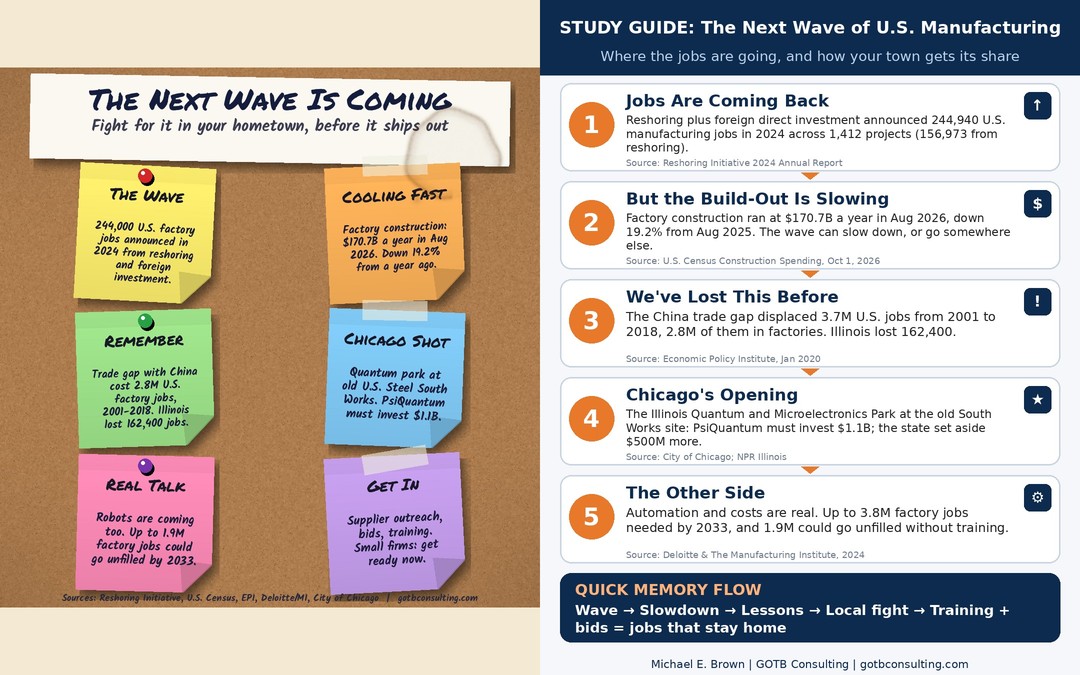
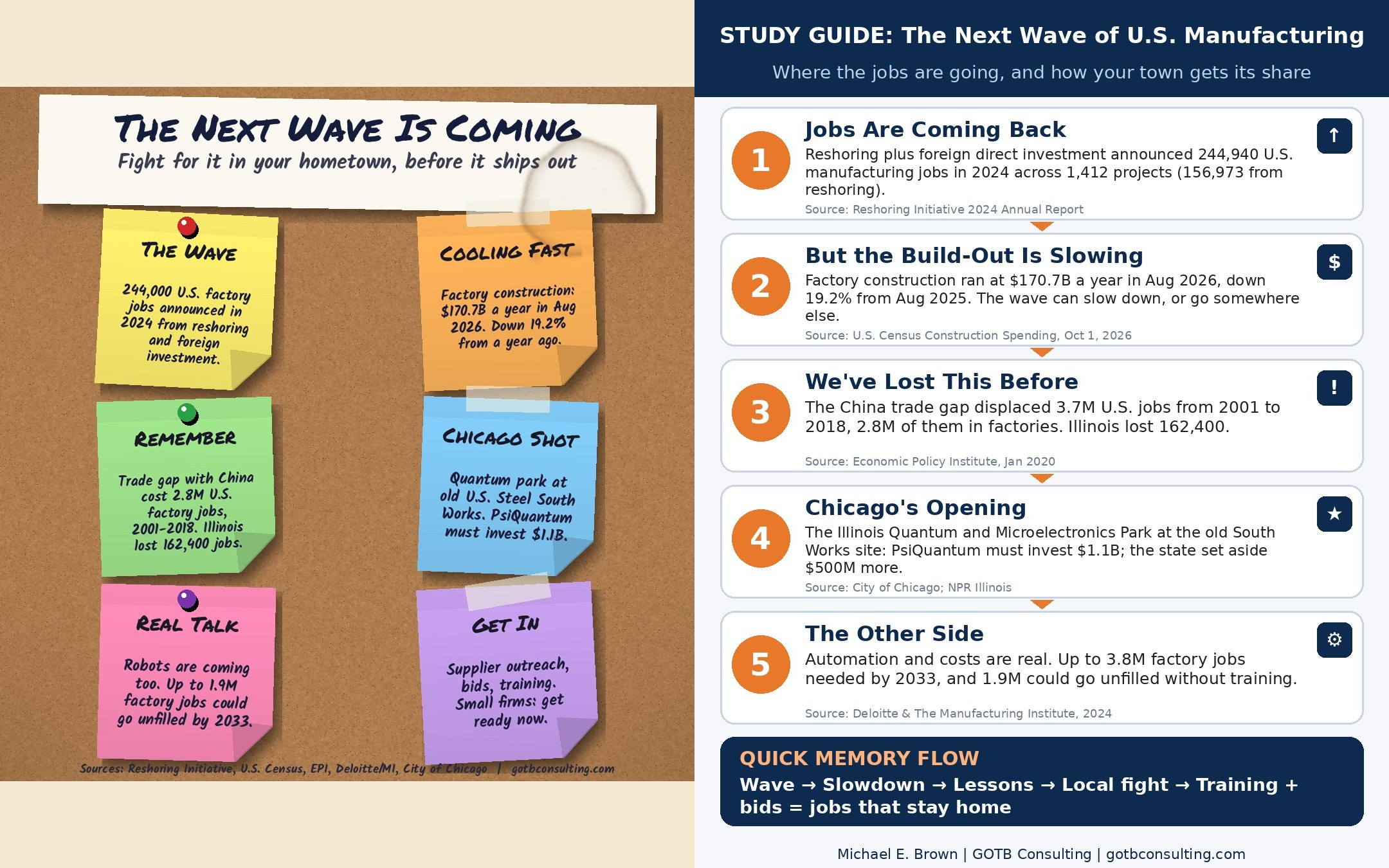
Read the text version of the graphic
Sticky notes.
- The Wave: 244,000 U.S. factory jobs announced in 2024 from reshoring and foreign investment.
- Cooling Fast: Factory construction: $170.7B a year in Aug 2026. Down 19.2% from a year ago.
- Remember: Trade gap with China cost 2.8M U.S. factory jobs, 2001-2018. Illinois lost 162,400 jobs.
- Chicago Shot: Quantum park at old U.S. Steel South Works. PsiQuantum must invest $1.1B.
- Real Talk: Robots are coming too. Up to 1.9M factory jobs could go unfilled by 2033.
- Get In: Supplier outreach, bids, training. Small firms: get ready now.
Study guide.
- Jobs Are Coming Back: Reshoring plus foreign direct investment announced 244,940 U.S. manufacturing jobs in 2024 across 1,412 projects (156,973 from reshoring). (Reshoring Initiative 2024 Annual Report)
- But the Build-Out Is Slowing: Factory construction ran at $170.7B a year in Aug 2026, down 19.2% from Aug 2025. The wave can slow down, or go somewhere else. (U.S. Census Construction Spending, Oct 1, 2026)
- We've Lost This Before: The China trade gap displaced 3.7M U.S. jobs from 2001 to 2018, 2.8M of them in factories. Illinois lost 162,400. (Economic Policy Institute, Jan 2020)
- Chicago's Opening: The Illinois Quantum and Microelectronics Park at the old South Works site: PsiQuantum must invest $1.1B; the state set aside $500M more. (City of Chicago; NPR Illinois)
- The Other Side: Automation and costs are real. Up to 3.8M factory jobs needed by 2033, and 1.9M could go unfilled without training. (Deloitte & The Manufacturing Institute, 2024)
Key takeaway. Wave, slowdown, lessons, local fight, then training plus bids means jobs that stay home.
The numbers
The construction figure is preliminary and subject to revision. The EPI number is a model estimate from 2020. The 2033 figure is a projection from a survey-based study.
What the sources say
Announcements are up
The Reshoring Initiative counted 244,940 manufacturing jobs announced in 2024: 156,973 from companies bringing production back and 87,968 from foreign companies investing here, across 1,412 cases. An announcement is a plan. Jobs arrive only if the plant gets built and staffed.
Source: Reshoring Initiative, 2024 annual reportBuilding is cooling
The Census Bureau reports that manufacturing construction ran at a seasonally adjusted annual rate of $170.7 billion in August 2026, up 0.2% from July and down 19.2% from August 2025. The figures are preliminary.
Source: U.S. Census Bureau, Construction Spending, August 2026We have lost this before
The Economic Policy Institute estimates that the growing U.S. goods trade deficit with China displaced 3.7 million U.S. jobs from 2001 to 2018, including 2.8 million in manufacturing, and 162,400 in Illinois. It is a modeled estimate from a research group that takes a position on trade policy, so read it as one well-documented view.
Source: EPI, Jan. 30, 2020Chicago and the other side
A steel site becomes a quantum park
The City of Chicago approved a Cook County Class 8 MICRO property tax incentive covering about 480 acres of the former U.S. Steel site on the South Side, for the planned Illinois Quantum and Microelectronics Park. NPR Illinois reported in 2024 that the anchor tenant, PsiQuantum, must invest $1.1 billion, with about $200 million in state incentives. PsiQuantum says it broke ground in September 2025 and, in July 2026, announced $250,000 for South Chicago schools and STEM programs.
Source: City of Chicago, Oct. 30, 2024; NPR Illinois, July 26, 2024; PsiQuantum, July 21, 2026The labor gap and automation are real
Deloitte and The Manufacturing Institute found that manufacturers may need as many as 3.8 million new employees from 2024 to 2033 and that 1.9 million of those jobs could go unfilled. Automation and cost pressure are part of the picture too, so training matters as much as buildings.
Source: Deloitte and The Manufacturing Institute, Apr. 3, 2024Different years, different measures
The jobs figures are announcements, the spending figure is dollars, and the EPI and Deloitte studies are older estimates. They are not one data set, and we do not add them together. Each stat above carries its own date.
What this means for public projects
- Ready the site. Power, water, permits and a clear approval path decide where a plant goes. This is GOTB’s view from public-works experience, not a finding of these sources.
- Buy local when you can. Supplier outreach and plain bid documents let small and local firms compete for the work around a big plant.
- Plan the training. Apprenticeships and technical education fill the gap Deloitte describes.
- Watch the calendar. Incentive approvals, groundbreakings and bid notices show where work will come, and when.
- Everybody has to win. Workers, owners, neighbors and the city all benefit when a plant opens on time and the people are ready.
What we could not verify
- Census figures. They are preliminary and subject to revision.
- EPI estimate. It is a modeled estimate published in 2020 by an advocacy-oriented research group, and the Illinois figure counts jobs in all industries, not only factories.
- Reshoring Initiative. Counts come from announcements the group tracks, and 2024 may be revised.
- PsiQuantum investment. The $1.1 billion obligation and state incentives are as reported in July 2024. We did not re-verify the current terms.
- Procurement effects. None of these sources measures procurement directly. That part is our view from public work, and nothing here claims any firm will win work.
Sources, checked on October 17, 2026
- Reshoring Initiative, 2024 Annual Data Report (with 1Q2025)
- U.S. Census Bureau, “Monthly Construction Spending, August 2026” (released Oct. 1, 2026)
- Economic Policy Institute, “Growing China trade deficit cost 3.7 million American jobs between 2001 and 2018” (Jan. 30, 2020)
- Deloitte and The Manufacturing Institute, “Manufacturers need as many as 3.8 million new employees by 2033” (Apr. 3, 2024)
- City of Chicago, “Tax rebate approved for South Chicago quantum computing park” (Oct. 30, 2024)
- NPR Illinois, “Quantum business park coming to Chicago, backed by $700M from state of Illinois” (July 26, 2024)
- PsiQuantum, “PsiQuantum announces major investments in South Chicago training, education, and quantum workforce development programs” (July 21, 2026)
What is ours. The plain-words boxes and the points on contracts and procurement are GOTB’s interpretation, labeled as such. Everything else is quoted or counted from the sources above.
Claims and findings. This brief summarizes published reports and public data. It does not recommend any company, site or investment.
This page is general information, not legal, engineering, security or investment advice, and it does not promote any product or company. Figures are as reported by the sources linked, as of October 17, 2026.

About
Meet Michael E. Brown
President and Managing Partner, GOTB Consulting, LLC · Chicago
Michael E. Brown has 20+ years of governmental and municipal consulting and lobbying experience. He was lead contract negotiator on the $8.5B O’Hare 21 program and the $800M O’Hare rail extension, and lead lobbyist and contract negotiator on the $400M Chicago Department of Water Management lateral redevelopment. (Dollar figures are program sizes, not GOTB fees.)
He has worked with the Illinois legislature and public officials on public-private partnership (P3) policy, and has consulted to the Cook County Commission on reducing duplicative administrative offices. He is a frequent speaker at governmental and municipal functions, focuses on good government and healthier social and economic solutions for safe, successful neighborhoods, lives in Chicago, and serves on the Board of the March of Dimes.
- M.S., Psychology (1997), University of Iowa
- B.S., Psychology (1995), University of Iowa
About
Meet Richard Butler
Partner, GOTB Consulting, LLC · Chicago
Richard (Rich) Butler is a partner at GOTB Consulting and a 38-year veteran of Chicago city government. From August 2019 to February 2020 he served as First Deputy Commissioner and Chief Administrative Officer of the Chicago Department of Aviation (CDA), responsible for day-to-day administration and operations of O’Hare and Midway, including finance, contracts, operations, legal, human resources, workforce development, concessions, real estate and vehicle services. CDA manages the two airports with a federally funded budget of $8.5 billion. (Dollar figures are budget and program sizes, not GOTB fees.)
Before that, Rich was First Deputy Procurement Officer at the City’s Department of Procurement Services and Chief Administrative Officer of the Chicago Park District, where he oversaw procurement, audit, finance, warehousing and general administrative services on an estimated annual budget of $385 million and established district-wide policies and procedures. His City career began at the Department of Aviation as Director of Contracts Administration, and he also served as General Superintendent of the Department of Streets and Sanitation.
He completed the Chicago Accounting and Purchasing System Training Program and the City of Chicago Executive Management Program, was a key team member on the design and implementation plan for the City’s new eProcurement system, and is a member of the National Institute of Governmental Purchasing and the Purchasing Management Association of Chicago. He has served on the board of the Chicago Municipal Employees Credit Union and on the US Communities board, representing the City of Chicago, and traveled to South Korea to represent Chicago in the Kotra Alliance to bridge contracting opportunities. A native of Englewood, he attended De La Salle High School.
- B.S., Northern Illinois University








Fictional characters from GOTB’s original stories. Real-world facts always link to public sources.