
Token Flip?
A clip going around says AI usage “flipped” from 80/20 closed models to 80/20 open models in 12 weeks. The data underneath is real, and narrower than the headline. This brief shows what it measures, what it misses, and what a public buyer should write into an AI contract: buy the outcome, keep the model swappable.
As of October 16, 2026. Every figure below was checked against its source, and anything we could not verify is labeled.
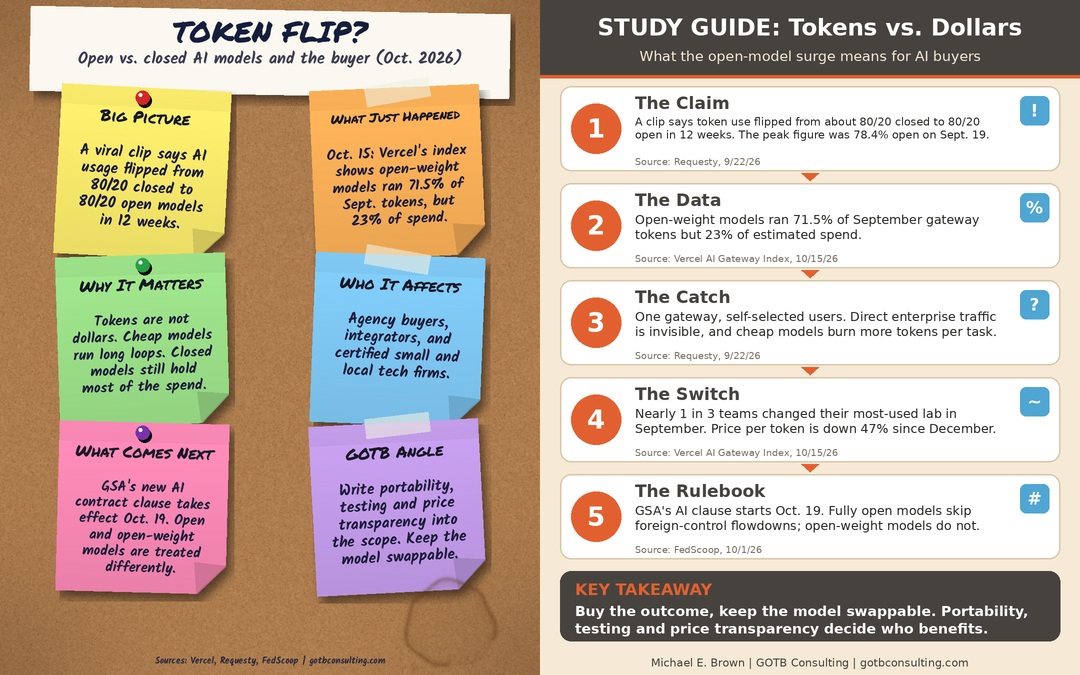
Read the text version of the graphic
Sticky notes.
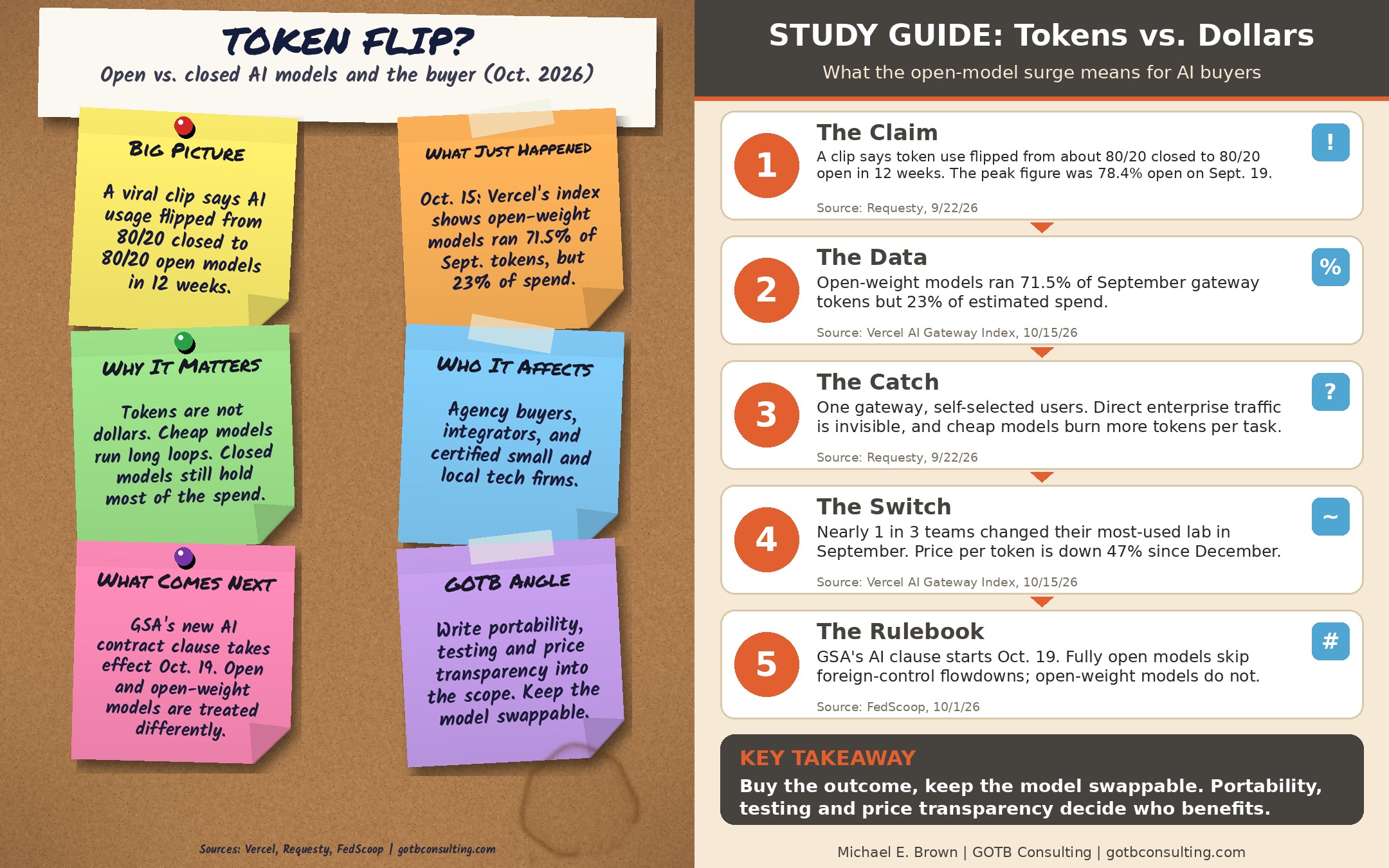
- Big Picture: A viral clip says AI usage flipped from 80/20 closed to 80/20 open models in 12 weeks.
- What Just Happened: Oct. 15: Vercel's index shows open-weight models ran 71.5% of Sept. tokens, but 23% of spend.
- Why It Matters: Tokens are not dollars. Cheap models run long loops. Closed models still hold most of the spend.
- Who It Affects: Agency buyers, integrators, and certified small and local tech firms.
- What Comes Next: GSA's new AI contract clause takes effect Oct. 19. Open and open-weight models are treated differently.
- GOTB Angle: Write portability, testing and price transparency into the scope. Keep the model swappable.
Study guide.
- The Claim: A clip says token use flipped from about 80/20 closed to 80/20 open in 12 weeks. The peak figure was 78.4% open on Sept. 19. (Requesty, 9/22/26)
- The Data: Open-weight models ran 71.5% of September gateway tokens but 23% of estimated spend. (Vercel AI Gateway Index, 10/15/26)
- The Catch: One gateway, self-selected users. Direct enterprise traffic is invisible, and cheap models burn more tokens per task. (Requesty, 9/22/26)
- The Switch: Nearly 1 in 3 teams changed their most-used lab in September. Price per token is down 47% since December. (Vercel AI Gateway Index, 10/15/26)
- The Rulebook: GSA's AI clause starts Oct. 19. Fully open models skip foreign-control flowdowns; open-weight models do not. (FedScoop, 10/1/26)
Key takeaway. Buy the outcome, keep the model swappable. Portability, testing and price transparency decide who benefits.
The numbers
Spend is estimated at list price. One gateway’s users are self-selected and are not the whole market. Details and limits are below.
What the three sources say
Tokens are not dollars
Vercel’s index says open-weight models ran 71.5% of September tokens on its gateway but only 23% of estimated spend. Open weight first took a majority of tokens in August, and its share of spend more than quadrupled since June. Average price per token is down 47% since December, and nearly one in three teams changed their most-used lab in September.
Source: Vercel, Oct. 15, 2026A narrow window
A competing gateway vendor, Requesty, says the 78.4% figure was one day on one gateway, used by teams already shopping on price. Direct enterprise traffic to the big labs is invisible to it, and cheap models can use more tokens per task, so cost per task is the better measure. Its own week showed open-weight models at about 55% of tokens and 15% of spend.
Source: Requesty, Sept. 22, 2026GSA’s new AI clause
FedScoop reports that GSA issued an AI acquisition clause, effective Oct. 19, as a class deviation, with formal rulemaking and public comment to follow. Primes need not flow foreign-control requirements down to fully open models, though open-weight models that only publish their weights do not get the same exception. It also sets a 7-day notice of material changes that increase bias, lower safety guardrails or degrade performance.
Source: FedScoop, Oct. 1, 2026Reading it fairly
Both vendors have a stake
Both gateway companies sell their own services, and each uses its own traffic. Vercel’s spend is estimated at list price. Neither dataset covers direct purchases from the big labs.
Source: Vercel; RequestySwitching is becoming normal
Even with caveats, the direction matters to buyers. Teams are changing providers and models quickly, and prices per token are falling. A contract that assumes one model forever will age badly.
Source: VercelBuy the outcome
Write the outcome, such as accuracy on your documents or response time, into the scope. Add portability, testing and price transparency so the vendor can change the model underneath without a new procurement.
What this means for public AI buyers
- Specify the outcome. Describe what the system must do, measured on your own data, not the model’s name.
- Require portability. Ask for exportable prompts, data and evaluation sets so you can change models.
- Test before and after. Require testing on any model change, and notice of material changes.
- Ask for price transparency. Price per task is clearer than price per token.
- Check the new clause. Read GSA’s clause on foreign-control terms for open and open-weight models. Certified small and local firms that can integrate, test and operate models for public agencies are worth watching.
What we could not verify
- Market-wide shares. Both datasets come from gateways and are not the whole market. We make no claim about overall usage.
- The “80/20 in 12 weeks” claim. We did not find a source for it as stated. Vercel’s figures are narrower, and the 78.4% figure was one day.
- Final clause text. We rely on FedScoop’s reporting of the GSA memo and did not read the memo itself. Rulemaking and comment are still to come.
- The viral clip. We did not verify any social video, and no social caption is used as a source on this page.
Sources, checked on October 16, 2026
- Vercel, “Open weight takes 71.5% of tokens and 23% of spend” (AI Gateway Production Index, Oct. 15, 2026)
- Requesty, “Open weight models are 55% of our tokens and 15% of our spend: what the 78.4% Vercel number does and does not tell you” (Sept. 22, 2026)
- FedScoop, “GSA issued an AI acquisition policy for new contracts. Here’s what it says.” (Oct. 1, 2026)
What is ours. The plain-words boxes and the points on contracts and procurement are GOTB’s interpretation, labeled as such. Everything else is quoted or counted from the sources above.
Claims and findings. This brief summarizes vendor data and trade press. It does not rank, recommend or criticize any AI model or provider.
This page is general information, not legal, engineering, security or investment advice, and it does not promote any product or company. Figures are as reported by the sources linked, as of October 16, 2026.

About
Meet Michael E. Brown
President and Managing Partner, GOTB Consulting, LLC · Chicago
Michael E. Brown has 20+ years of governmental and municipal consulting and lobbying experience. He was lead contract negotiator on the $8.5B O’Hare 21 program and the $800M O’Hare rail extension, and lead lobbyist and contract negotiator on the $400M Chicago Department of Water Management lateral redevelopment. (Dollar figures are program sizes, not GOTB fees.)
He has worked with the Illinois legislature and public officials on public-private partnership (P3) policy, and has consulted to the Cook County Commission on reducing duplicative administrative offices. He is a frequent speaker at governmental and municipal functions, focuses on good government and healthier social and economic solutions for safe, successful neighborhoods, lives in Chicago, and serves on the Board of the March of Dimes.
- M.S., Psychology (1997), University of Iowa
- B.S., Psychology (1995), University of Iowa
About
Meet Richard Butler
Partner, GOTB Consulting, LLC · Chicago
Richard (Rich) Butler is a partner at GOTB Consulting and a 38-year veteran of Chicago city government. From August 2019 to February 2020 he served as First Deputy Commissioner and Chief Administrative Officer of the Chicago Department of Aviation (CDA), responsible for day-to-day administration and operations of O’Hare and Midway, including finance, contracts, operations, legal, human resources, workforce development, concessions, real estate and vehicle services. CDA manages the two airports with a federally funded budget of $8.5 billion. (Dollar figures are budget and program sizes, not GOTB fees.)
Before that, Rich was First Deputy Procurement Officer at the City’s Department of Procurement Services and Chief Administrative Officer of the Chicago Park District, where he oversaw procurement, audit, finance, warehousing and general administrative services on an estimated annual budget of $385 million and established district-wide policies and procedures. His City career began at the Department of Aviation as Director of Contracts Administration, and he also served as General Superintendent of the Department of Streets and Sanitation.
He completed the Chicago Accounting and Purchasing System Training Program and the City of Chicago Executive Management Program, was a key team member on the design and implementation plan for the City’s new eProcurement system, and is a member of the National Institute of Governmental Purchasing and the Purchasing Management Association of Chicago. He has served on the board of the Chicago Municipal Employees Credit Union and on the US Communities board, representing the City of Chicago, and traveled to South Korea to represent Chicago in the Kotra Alliance to bridge contracting opportunities. A native of Englewood, he attended De La Salle High School.
- B.S., Northern Illinois University








Fictional characters from GOTB’s original stories. Real-world facts always link to public sources.