
Demo vs. Deliverable
A vendor demo can be real and still not be what you are buying. A widely shared vehicle clip this week is a handy case: the reporting describes a demonstration, not a launch. This brief is not about the car or the company. It uses the story to show how a public buyer can check what was shown, and what the contract should say.
As of October 16, 2026. Every figure below was checked against its source that day, and anything we could not verify is labeled.
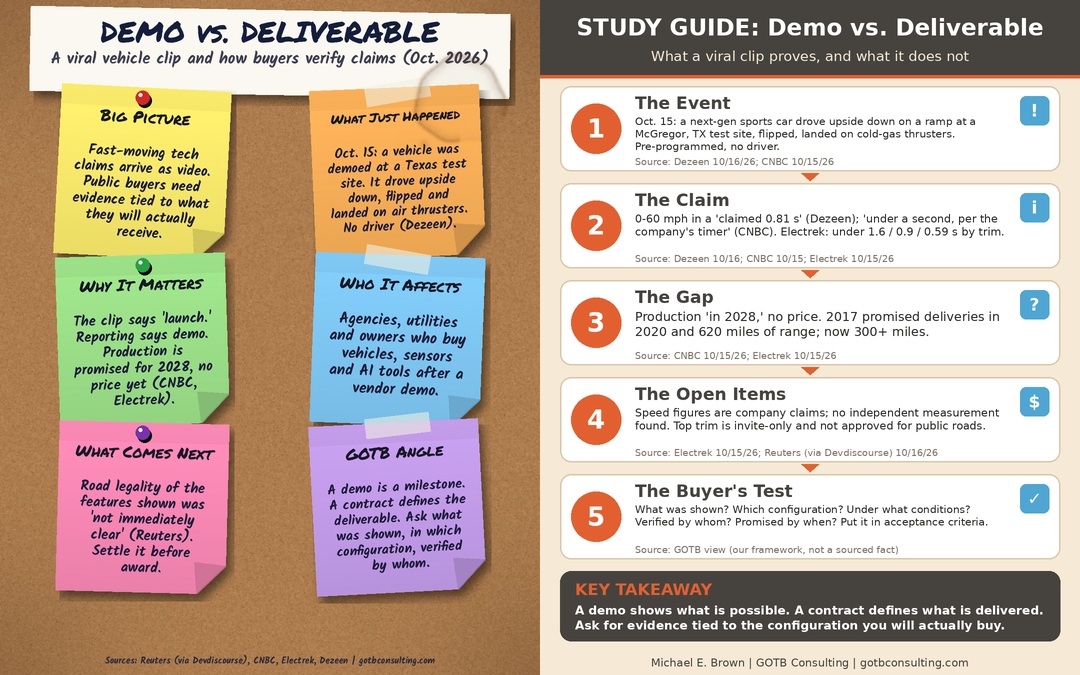
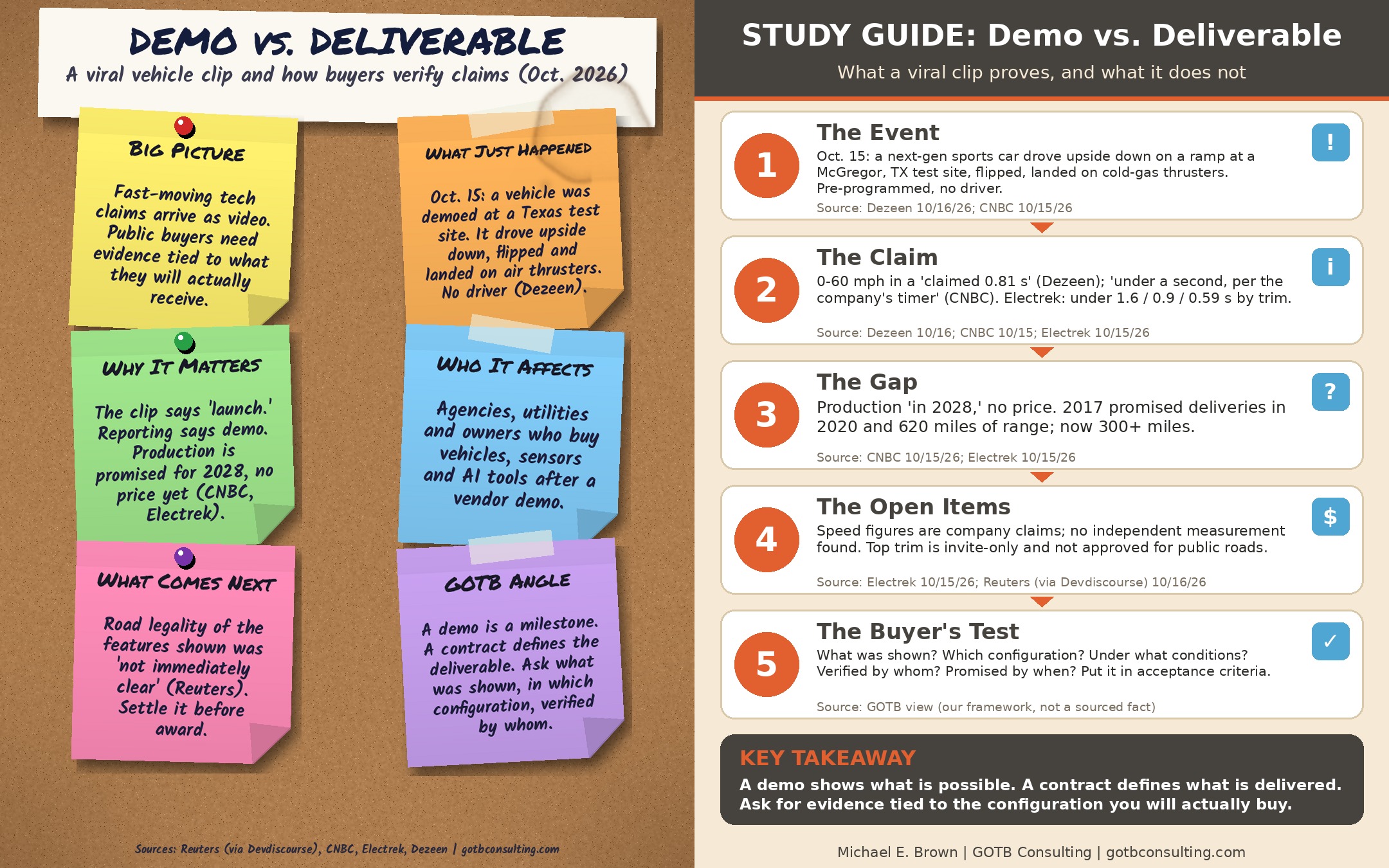
Read the text version of the graphic
Sticky notes.
- Big Picture: Fast-moving tech claims arrive as video. Public buyers need evidence tied to what they will actually receive.
- What Just Happened: Oct. 15: a vehicle was demoed at a Texas test site. It drove upside down, flipped and landed on air thrusters. No driver (Dezeen).
- Why It Matters: The clip says “launch.” Reporting says demo. Production is promised for 2028, no price yet (CNBC, Electrek).
- Who It Affects: Agencies, utilities and owners who buy vehicles, sensors and AI tools after a vendor demo.
- What Comes Next: Road legality of the features shown was “not immediately clear” (Reuters). Settle it before award.
- GOTB Angle: A demo is a milestone. A contract defines the deliverable. Ask what was shown, in which configuration, verified by whom.
Study guide.
- The Event: Oct. 15: a next-gen sports car drove upside down on a ramp at a McGregor, TX test site, flipped, landed on cold-gas thrusters. Pre-programmed, no driver (Dezeen 10/16/26; CNBC 10/15/26).
- The Claim: 0-60 mph in a “claimed 0.81 s” (Dezeen); “under a second, per the company’s timer” (CNBC). Electrek: under 1.6 / 0.9 / 0.59 s by trim (Dezeen 10/16; CNBC 10/15; Electrek 10/15/26).
- The Gap: Production “in 2028,” no price. 2017 promised deliveries in 2020 and 620 miles of range; now 300+ miles (CNBC 10/15/26; Electrek 10/15/26).
- The Open Items: Speed figures are company claims; no independent measurement found. Top trim is invite-only and not approved for public roads (Electrek 10/15/26; Reuters via Devdiscourse 10/16/26).
- The Buyer’s Test: What was shown? Which configuration? Under what conditions? Verified by whom? Promised by when? Put it in acceptance criteria (GOTB view, our framework, not a sourced fact).
Key takeaway. A demo shows what is possible. A contract defines what is delivered. Ask for evidence tied to the configuration you will actually buy.
The numbers
Every number here is a claim reported by the outlet named under it. None is an independent measurement. Details and limits are below.
What was shown, and what to call it
A live demonstration in Texas
On Thursday, October 15, 2026, a livestreamed event at a test site in McGregor, Texas, showed a two-seat electric sports car. Reuters reports it was shown driving upside down on a ramp using a suction system, turning in the air and landing using in-built thrusters. Dezeen adds that it also became airborne over a row of parked vehicles.
Source: Reuters (syndicated copy), Oct. 16, 2026; CNBC, Oct. 15, 2026; Dezeen, Oct. 16, 2026A demonstration, not a launch
Nothing here was a product launch in the sense a buyer cares about: no price was announced, and CNBC reports the company’s CEO said production would begin in 2028. Words drift in headlines and social captions. One of the articles we cite carries the headline “Tesla launches flying Roadster concept car,” while its own text describes a demonstration. For a buyer, the difference matters: a demonstration shows what a prototype can do on one day, and a launch means a product you can order, receive and rely on.
Source: Dezeen, Oct. 16, 2026; CNBC, Oct. 15, 2026Scripted, with no driver
Dezeen reports that “the demonstration used a pre-programmed sequence with no driver.” In our view that is a useful detail for any buyer: a repeatable, scripted run on a prepared site is a different test from open-road use. Reuters adds that the use and legality of such features on public roads “were not immediately clear.”
Source: Dezeen, Oct. 16, 2026; Reuters (syndicated copy), Oct. 16, 2026The claims, and who is making them
The 0-60 mph claim
Dezeen reports the car reached 60 mph in a claimed 0.81 seconds. CNBC says under a second “according to Tesla’s timer,” and Reuters reports the company’s CEO said less than one second and a top speed over 230 mph.
We found no independent measurement in these sources, so the figure is a vendor claim.
Source: Dezeen; CNBC; ReutersThree trims, different claims
Electrek, citing a thread the company posted on X after the event, lists three versions: Performance (“road ready”, 0-60 mph in under 1.6 seconds), Thrust (under 0.9 seconds) and Rocket (one seat, under 0.59 seconds, top speed over 230 mph, invite only).
Electrek also notes that the company’s own page states the Rocket “isn’t approved for public road use.” Electrek adds that the stunts making the headlines are on trims that are invite-only or limited.
Source: Electrek, Oct. 15, 20262028, and no price
CNBC reports the CEO said production would begin in 2028 and that the price was not announced. Electrek reports that no price was given for any of the three versions and that there is no production date other than “2028, actually,” a direct quote from the CEO.
Source: CNBC; ElectrekThe gap: what was promised, and when
Promises change between a first demonstration and a delivered product. Electrek compared the 2017 promises with today’s quotes:
| Item | Promised in 2017 | Quoted now |
|---|---|---|
| Deliveries | 2020 | 2028 (“2028, actually”) |
| Range | 620 miles | Over 300 miles |
| Seats | Four (2+2) | Two at most |
| Top speed | Above 250 mph | Over 230 mph (Rocket trim) |
| 0-60 mph | 1.9 seconds | Under 1.6 seconds (Performance trim) |
What it says: specifications move over time, and some move in the buyer’s favor (acceleration) and some against (range, seats, delivery date). CNBC reports that the company “has since missed every targeted delivery date” since 2017.
Both things can be true. Electrek’s own take: “The engineering here is real.” The same article says the stunts making the headlines are on trims that are invite-only or limited, and not road legal. A demo can be impressive and still not match what is on the order form.
Source: Electrek, Oct. 15, 2026; CNBC, Oct. 15, 2026The buyer’s test
What was shown?
Ask for the exact event, date and recording. Was it live or edited, and was it a prototype or a production unit?
In which configuration?
Match the demonstrated version to the version in the contract: trim, options, software and hardware revision.
Under what conditions?
Ask about the site, weather, load, duration and whether the run was scripted or repeatable by an independent party.
Verified by whom?
A vendor’s own timer is a claim. Ask for a test witnessed or measured by someone with no stake in the result.
Promised by when?
Put delivery dates, quantities and remedies for delay in the contract, not in a keynote.
What this means for you
- Applies to any purchase. A vehicle, a sensor, a software tool or an AI model: the same five questions work whenever a public agency or utility is shown an impressive demo.
- Separate the milestone from the delivery. Pay for a demonstration as a demonstration, and tie the main payment to acceptance of the delivered item.
- Ask for the test plan. Who runs the acceptance test, on whose site, with what pass mark, and what happens if it fails?
- Check the road, rules and permits. Reuters notes the legality of the features shown was not immediately clear. For a public buyer, that is a question to settle before award.
- Keep it fair. Vendors who can prove their claims earn trust, and agencies get what they paid for.
What we could not verify
- Speed figures. The 0.81-second figure and the trim specifications are company claims as reported. We found no independent measurement.
- How the stunts were controlled. We use only Dezeen’s description (pre-programmed, no driver). Other outlets describe the setup differently, and we did not resolve that.
- Deposits. Reuters lists a $50,000 deposit for the Performance version and $250,000 for Thrust. Electrek describes $5,000 due immediately and $45,000 within 10 days. We do not rely on these figures.
- The Reuters text. We read it as a syndicated copy on Devdiscourse, and did not open the original on reuters.com.
- The viral clip itself. We did not verify the video frames of any social clip, and no social caption is used as a source on this page.
Timeline
- Nov. 2017A next-generation prototype is shown, and production is promised for 2020 (Electrek).
- 2020The promised delivery year passes, and CNBC reports every targeted delivery date since has been missed.
- Oct. 15, 2026Livestreamed demonstration at a test site in McGregor, Texas (CNBC, Reuters).
- After the eventConfiguration details are posted on the company’s X account, with no price and no production date other than 2028 (Electrek).
- 2028Production target stated at the event (CNBC, Dezeen).
Sources, checked on October 16, 2026
- Reuters, “Tesla unveils next generation Roadster sports EV with SpaceX thrusters” (Oct. 16, 2026; syndicated copy on Devdiscourse, original not opened)
- CNBC, “Tesla Roadster reveal: What to know about the delayed EV” (Oct. 15, 2026)
- Electrek, “Tesla unveils Cyberfied new Roadster that can kickflip” (Oct. 15, 2026)
- Dezeen, “Tesla launches flying Roadster concept car” (Oct. 16, 2026)
What is ours. The plain-words boxes, the buyer’s test and the closing points on contracts are GOTB’s interpretation, labeled as such. Everything else is quoted or counted from the sources above, and each claim is attributed to the outlet that reported it. We do not use any number we could not open and check.
Claims and findings. The performance figures described here are claims made by the vendor and reported by the news outlets named. They are not independent findings, and this page does not say any claim is false. It is not about the vehicle or the company, and it contains no financial or investment commentary.
Disclosure: GOTB Consulting advises on public infrastructure work in Chicago and has no relationship with the company or the event discussed. This page is general information, not legal advice, and it does not promote any product or company.

About
Meet Michael E. Brown
President and Managing Partner, GOTB Consulting, LLC · Chicago
Michael E. Brown has 20+ years of governmental and municipal consulting and lobbying experience. He was lead contract negotiator on the $8.5B O’Hare 21 program and the $800M O’Hare rail extension, and lead lobbyist and contract negotiator on the $400M Chicago Department of Water Management lateral redevelopment. (Dollar figures are program sizes, not GOTB fees.)
He has worked with the Illinois legislature and public officials on public-private partnership (P3) policy, and has consulted to the Cook County Commission on reducing duplicative administrative offices. He is a frequent speaker at governmental and municipal functions, focuses on good government and healthier social and economic solutions for safe, successful neighborhoods, lives in Chicago, and serves on the Board of the March of Dimes.
- M.S., Psychology (1997), University of Iowa
- B.S., Psychology (1995), University of Iowa
About
Meet Richard Butler
Partner, GOTB Consulting, LLC · Chicago
Richard (Rich) Butler is a partner at GOTB Consulting and a 38-year veteran of Chicago city government. From August 2019 to February 2020 he served as First Deputy Commissioner and Chief Administrative Officer of the Chicago Department of Aviation (CDA), responsible for day-to-day administration and operations of O’Hare and Midway, including finance, contracts, operations, legal, human resources, workforce development, concessions, real estate and vehicle services. CDA manages the two airports with a federally funded budget of $8.5 billion. (Dollar figures are budget and program sizes, not GOTB fees.)
Before that, Rich was First Deputy Procurement Officer at the City’s Department of Procurement Services and Chief Administrative Officer of the Chicago Park District, where he oversaw procurement, audit, finance, warehousing and general administrative services on an estimated annual budget of $385 million and established district-wide policies and procedures. His City career began at the Department of Aviation as Director of Contracts Administration, and he also served as General Superintendent of the Department of Streets and Sanitation.
He completed the Chicago Accounting and Purchasing System Training Program and the City of Chicago Executive Management Program, was a key team member on the design and implementation plan for the City’s new eProcurement system, and is a member of the National Institute of Governmental Purchasing and the Purchasing Management Association of Chicago. He has served on the board of the Chicago Municipal Employees Credit Union and on the US Communities board, representing the City of Chicago, and traveled to South Korea to represent Chicago in the Kotra Alliance to bridge contracting opportunities. A native of Englewood, he attended De La Salle High School.
- B.S., Northern Illinois University








Fictional characters from GOTB’s original stories. Real-world facts always link to public sources.