Paper vs. Pavement
An invoice is not the work. When public money pays for repairs, roads or pipes, someone has to check both the paperwork and the pavement. This brief walks through one new case, three data points on how big and how slow the problem can be, and how data tools help spot trouble early, with a link to every source.
As of October 16, 2026. Every figure below was checked against its source that day.
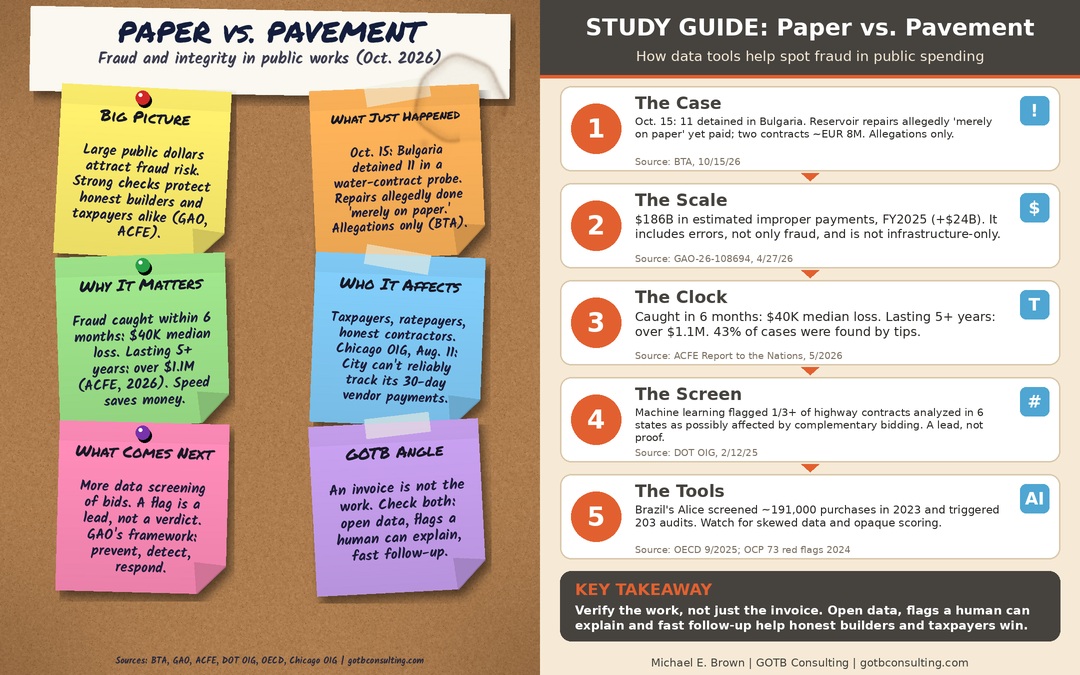
Read the text version of the graphic
Sticky notes.
- Big Picture: Large public dollars attract fraud risk. Strong checks protect honest builders and taxpayers alike (GAO, ACFE).
- What Just Happened: Oct. 15: Bulgaria detained 11 in a water-contract probe. Repairs allegedly done “merely on paper.” Allegations only (BTA).
- Why It Matters: Fraud caught within 6 months: $40K median loss. Lasting 5+ years: over $1.1M (ACFE, 2026). Speed saves money.
- Who It Affects: Taxpayers, ratepayers, honest contractors. Chicago OIG, Aug. 11: City can’t reliably track its 30-day vendor payments.
- What Comes Next: More data screening of bids. A flag is a lead, not a verdict. GAO’s framework: prevent, detect, respond.
- GOTB Angle: An invoice is not the work. Check both: open data, flags a human can explain, fast follow-up.
Study guide.
- The Case: Oct. 15: 11 detained in Bulgaria. Reservoir repairs allegedly “merely on paper” yet paid; two contracts about EUR 8M. Allegations only (BTA, 10/15/26).
- The Scale: $186B in estimated improper payments, FY2025 (+$24B). It includes errors, not only fraud, and is not infrastructure-only (GAO-26-108694, 4/27/26).
- The Clock: Caught in 6 months: $40K median loss. Lasting 5+ years: over $1.1M. 43% of cases were found by tips (ACFE, 5/2026).
- The Screen: Machine learning flagged at least a third of highway contracts analyzed in 6 states as possibly affected by complementary bidding. A lead, not proof (DOT OIG, 2/12/25).
- The Tools: Brazil’s Alice screened about 191,000 purchases in 2023 and triggered 203 audits. Watch for skewed data and opaque scoring (OECD 9/2025; OCP 73 red flags, 2024).
Key takeaway. Verify the work, not just the invoice. Open data, flags a human can explain and fast follow-up help honest builders and taxpayers win.
The numbers
These five numbers come from five different sources that measure different things. They are not added together or compared with each other. Each one is explained below, with its limits.
The case: paper, but no pavement
Eleven detained in Bulgaria
On October 15, 2026, the Bulgarian News Agency (BTA) reported that 11 people were detained in an investigation into alleged corruption involving water-utility contracts. Investigators say work on reservoirs for drinking water was done “only partially, to a poor standard or merely on paper,” yet it was “formally accepted and paid for in full.”
Source: BTA, Oct. 15, 2026Two contracts, about EUR 8 million
BTA reports that payments on two of the contracts alone were more than BGN 13 million before VAT and nearly BGN 16 million with VAT, which is about EUR 8 million. The procurements were allegedly arranged in advance. The investigation is ongoing.
Source: BTA, Oct. 15, 2026Allegations, not findings
These are claims by Bulgarian investigators as reported by a news agency. No court has ruled. It is a Bulgarian case, not a U.S. one, and nothing here says a similar case exists in Chicago or anywhere else in the U.S. It is on this page because it shows, in one sentence, why an invoice and the finished work are two different things.
The scale: a very large number with a narrow meaning
$186 billion in improper payments
The U.S. Government Accountability Office (GAO) reports that federal agencies estimated about $186 billion in improper payments for fiscal year 2025, up about $24 billion from fiscal year 2024.
Source: GAO-26-108694, Apr. 27, 2026Errors as well as fraud
GAO says improper payments result from overpayments, fraud or other causes. The figure counts payments made in error, too, so it is not a measure of fraud alone.
Source: GAO press release, Apr. 27, 2026Not an infrastructure number
GAO says 73% of the total sits in five program areas, including Medicare and Medicaid. Our reading of that list is that health and benefit programs dominate it, so this is not a construction or public-works figure. We use it only to show how large the payment-integrity problem is across government.
Source: GAO press release, Apr. 27, 2026The clock: the longer it runs, the more it costs
The Association of Certified Fraud Examiners (ACFE) studied 2,402 occupational fraud cases from 143 countries and territories. The median scheme lasted 12 months before it was detected. The longer a scheme ran, the larger the loss:
What it says: speed matters. Fraud caught within six months had a median loss of $40,000, and schemes lasting more than five years had median losses above $1.1 million. Tips were the most common way fraud was found (43% of cases), and ACFE says controls such as management review, proactive data monitoring and surprise audits were associated with stronger outcomes.
What it does not say: that every long scheme is huge or every short one is small. These are medians from the cases ACFE’s fraud examiners reported. The study covers occupational fraud in organizations of all kinds, not only public works.
Source: ACFE, Key Findings from Occupational Fraud 2026, May 19, 2026The screen: how data helps point the way
Machine learning on highway bids
The U.S. Department of Transportation’s Office of Inspector General (DOT OIG) used machine learning on highway contracts in six states (Florida, Georgia, North Carolina, New Jersey, Pennsylvania and South Carolina). It flagged at least a third of the contracts it analyzed as potentially affected by complementary bidding, a practice where firms submit bids that are not truly competitive.
Source: DOT OIG, Feb. 12, 20255.2% to 10.2% higher
The OIG estimated that flagged contracts ran 5.2% to 10.2% higher in cost, depending on the state, or about $1.19 billion cumulatively (in 2021 dollars) across the six states.
Source: DOT OIG, Feb. 12, 2025A flag is a lead, not proof
The OIG itself calls these contracts “potentially” affected, and in a separate analysis of flagged firm pairs it notes limited evidence of an effect on costs. A flag tells an auditor where to look first. It does not say anyone did anything wrong.
Source: DOT OIG, Feb. 12, 2025Close to home: the records come first
Can the City tell whether it pays on time?
On August 11, 2026, the Chicago Office of Inspector General published an audit titled “City Cannot Determine Whether It Meets Its 30-Day Vendor Payment Goal; Longstanding Challenges Continue to Affect Chicago’s Contractors.” Coverage by The Center Square says the audit found the Department of Finance cannot reliably measure how quickly it pays contracted vendors because of “data inaccuracies,” and that three studies since 2009 and a 2021 working group had flagged slow payment.
This is a payment-timeliness finding, not a fraud finding. It is here because every data tool depends on the data underneath it: if a city cannot reliably measure its own payments, a screening tool has little to work with.
The tools, and their limits
Brazil’s “Alice”
The OECD describes a Brazilian audit-agency tool called Alice that analyzed nearly 191,000 acquisitions in 2023 and triggered 203 audits. The OECD also reports it cut the average time an audit process requires from 400 days to 8.
Source: OECD, Governing with Artificial Intelligence, Sep. 18, 202573 red-flag indicators
The Open Contracting Partnership’s 2024 guide lists 73 red-flag indicators for public procurement, mapped to the Open Contracting Data Standard, so that open contracting data can be screened the same way each time.
Source: Open Contracting Partnership, Red Flags in Public Procurement, 2024Skewed data, opaque scores
The OECD cautions that these tools can inherit skewed training data, can lack explainability, and need ongoing monitoring. That is why a flag a human can explain is worth more than a score nobody can.
Source: OECD, Sep. 18, 2025Brazil is not Chicago. This example shows what a data tool can do elsewhere. It is not evidence about U.S. projects.
What comes next
GAO’s fraud risk framework organizes anti-fraud work around three ideas: prevent, detect and respond, with an emphasis on prevention and on monitoring and feedback. Combine that with the numbers above and our view is this: the best defense pairs open data that anyone can check, flags a human can explain, and fast follow-up, because the clock is the cost. Honest contractors and taxpayers both win when checks are quick and fair.
Source: GAO-15-593SP, A Framework for Managing Fraud Risks in Federal Programs, Jul. 28, 2015What this means for you
- Check the work, not only the invoice. For any public project, ask who confirmed the work was done and how, and whether that record is public.
- Ask for the data. Are bids, awards and payments published in a form anyone can search? Open data lets many eyes do the screening.
- Treat a flag as a lead. A statistical flag points to where to look. Wait for the follow-up before drawing a conclusion about anyone.
- Speak up early. Tips were how 43% of frauds in ACFE’s study were found. If you see something wrong on a public project, tell the agency’s inspector general or ethics office. Source: ACFE, May 19, 2026
- As a taxpayer or ratepayer, the lesson is speed. A problem found in months costs far less than one found in years.
Timeline
- Jul. 28, 2015GAO publishes A Framework for Managing Fraud Risks in Federal Programs (GAO-15-593SP).
- 2024The Open Contracting Partnership publishes its guide to 73 procurement red flags.
- Feb. 12, 2025DOT OIG reports its machine-learning screen of highway bids in six states.
- Sep. 18, 2025The OECD publishes its review of AI in public procurement, including Brazil’s Alice.
- Apr. 27, 2026GAO reports an estimated $186 billion in federal improper payments for FY2025.
- May 19, 2026ACFE releases key findings from Occupational Fraud 2026: A Report to the Nations.
- Aug. 11, 2026Chicago OIG audit finds the City cannot determine whether it meets its 30-day vendor payment goal.
- Oct. 15, 2026BTA reports 11 detained in a Bulgarian water-contract investigation (allegations; investigation ongoing).
Questions to ask
Who confirms the work was done?
Ask which person or office signs off that the finished work matches the invoice, and whether that sign-off is public.
Is the contract data open?
Ask whether bids, awards, change orders and payments are published in a searchable, downloadable form.
What happens after a flag?
Ask who reviews a screening flag, how fast, and how the result is reported back.
Sources, checked on October 16, 2026
- BTA, “Eleven Detained in Investigation into Alleged Corruption Scheme Involving Water Utility Contracts” (Oct. 15, 2026)
- GAO-26-108694, Payment Integrity: Agencies’ Estimated Improper Payments Increased to $186 Billion in Fiscal Year 2025 (Apr. 27, 2026)
- GAO press release on the FY2025 improper payments estimate, including the 73% / five-program figure (Apr. 27, 2026)
- ACFE, Key Findings from Occupational Fraud 2026: A Report to the Nations (May 19, 2026)
- DOT Office of Inspector General, “A More Systematic Approach Is Needed To Identify Potential Anticompetitive Bidding on Federal-Aid Highway Projects” (Feb. 12, 2025)
- Chicago Office of Inspector General, press-release listing for the Aug. 11, 2026 audit of vendor payment timeliness
- The Center Square via cities929.com, “Inspector finds ‘data inaccuracies’ in Chicago finance department” (Aug. 12, 2026)
- OECD, “AI in public procurement,” Governing with Artificial Intelligence, Box 5.25 on Brazil’s Alice (Sep. 18, 2025)
- Open Contracting Partnership, Red Flags in Public Procurement (2024)
- GAO-15-593SP, A Framework for Managing Fraud Risks in Federal Programs (Jul. 28, 2015)
What is ours. The plain-words boxes, the reading that the GAO figure is not an infrastructure number, and the closing view on open data and human-explainable flags are GOTB’s interpretation, labeled as such. Everything else is quoted or counted from the sources above. We do not use any number we could not open and check. The Chicago OIG audit’s own page could not be located, so it is cited through the OIG’s press-release listing and press coverage.
Allegations and findings. The Bulgarian case describes allegations by investigators as reported by a news agency; no court finding is reported. Screening flags, in the sources and on this page, are leads and not proof of wrongdoing by any person or company.
Disclosure: GOTB Consulting advises on public infrastructure work in Chicago. This page describes public reports and public numbers. It is general information, not legal advice, and it does not promote any product or company.

About
Meet Michael E. Brown
President and Managing Partner, GOTB Consulting, LLC · Chicago
Michael E. Brown has 20+ years of governmental and municipal consulting and lobbying experience. He was lead contract negotiator on the $8.5B O’Hare 21 program and the $800M O’Hare rail extension, and lead lobbyist and contract negotiator on the $400M Chicago Department of Water Management lateral redevelopment. (Dollar figures are program sizes, not GOTB fees.)
He has worked with the Illinois legislature and public officials on public-private partnership (P3) policy, and has consulted to the Cook County Commission on reducing duplicative administrative offices. He is a frequent speaker at governmental and municipal functions, focuses on good government and healthier social and economic solutions for safe, successful neighborhoods, lives in Chicago, and serves on the Board of the March of Dimes.
- M.S., Psychology (1997), University of Iowa
- B.S., Psychology (1995), University of Iowa
About
Meet Richard Butler
Partner, GOTB Consulting, LLC · Chicago
Richard (Rich) Butler is a partner at GOTB Consulting and a 38-year veteran of Chicago city government. From August 2019 to February 2020 he served as First Deputy Commissioner and Chief Administrative Officer of the Chicago Department of Aviation (CDA), responsible for day-to-day administration and operations of O’Hare and Midway, including finance, contracts, operations, legal, human resources, workforce development, concessions, real estate and vehicle services. CDA manages the two airports with a federally funded budget of $8.5 billion. (Dollar figures are budget and program sizes, not GOTB fees.)
Before that, Rich was First Deputy Procurement Officer at the City’s Department of Procurement Services and Chief Administrative Officer of the Chicago Park District, where he oversaw procurement, audit, finance, warehousing and general administrative services on an estimated annual budget of $385 million and established district-wide policies and procedures. His City career began at the Department of Aviation as Director of Contracts Administration, and he also served as General Superintendent of the Department of Streets and Sanitation.
He completed the Chicago Accounting and Purchasing System Training Program and the City of Chicago Executive Management Program, was a key team member on the design and implementation plan for the City’s new eProcurement system, and is a member of the National Institute of Governmental Purchasing and the Purchasing Management Association of Chicago. He has served on the board of the Chicago Municipal Employees Credit Union and on the US Communities board, representing the City of Chicago, and traveled to South Korea to represent Chicago in the Kotra Alliance to bridge contracting opportunities. A native of Englewood, he attended De La Salle High School.
- B.S., Northern Illinois University








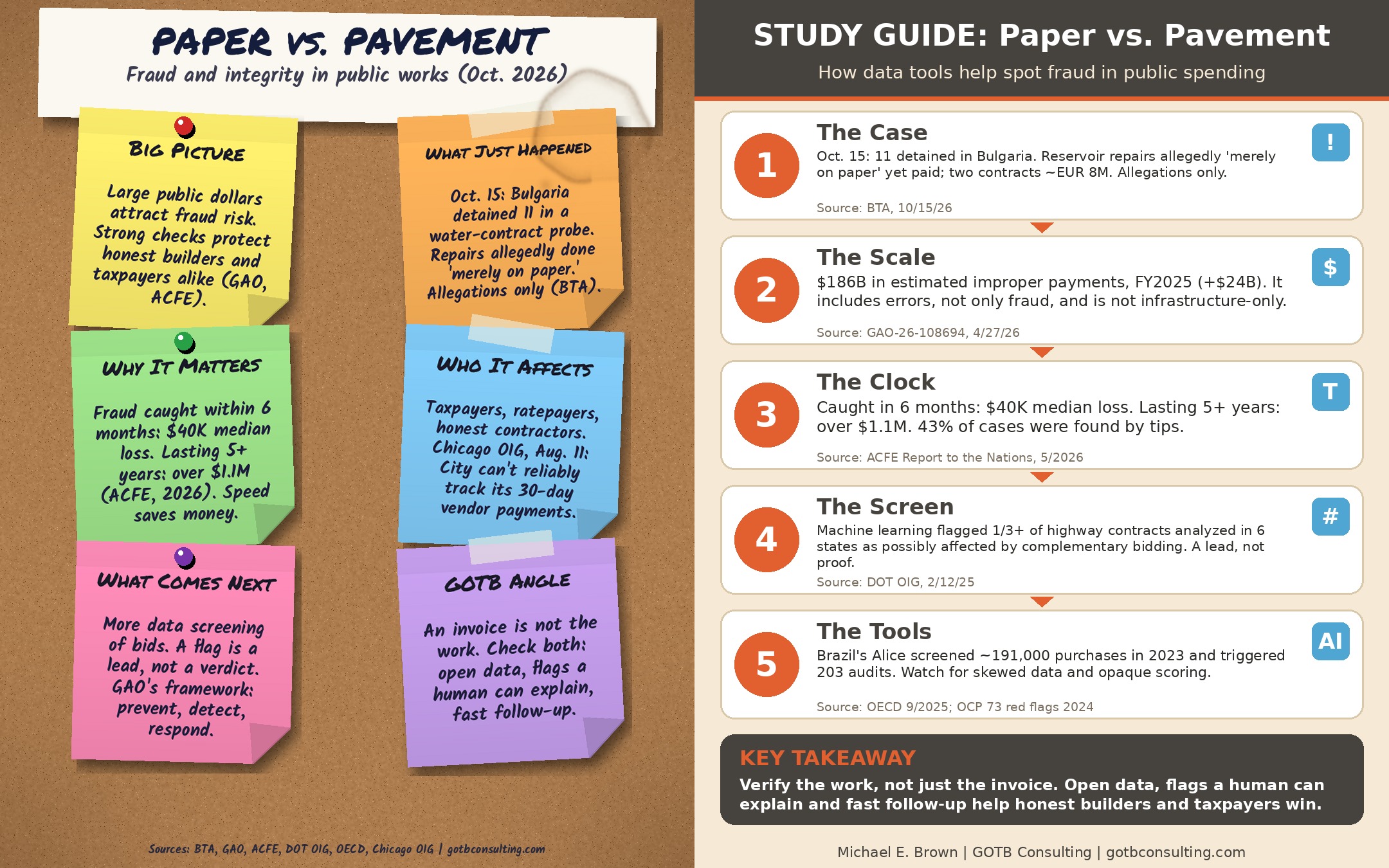
Fictional characters from GOTB’s original stories. Real-world facts always link to public sources.